haproxy-spoe-rs: A Rust SPOA Agent Library for HAProxy
Table of contents
haproxy-spoe-rs is a Rust library for writing HAProxy SPOE agents. This post covers what SPOE is, the design decisions behind the library, and how its throughput compares to the Go reference implementation.
Why this library?🔗
This library is not a replacement for the Go implementation — it is a Rust-native alternative for teams that are already using Rust and want to keep their SPOA agent in the same language and toolchain.
Both implementations are solid choices. The Go version is mature, well-tested, and integrates naturally into Go-based infrastructures. This library exists for the Rust ecosystem:
- Type safety end-to-end. The SPOE wire types (
TypedData,Scope,Action) are Rust enums — the compiler rejects mismatched types at build time, not at runtime. - No separate process to operate. Embed the agent directly in an existing Rust binary via
Agent::new(handler).serve(listener), or run it standalone. - Minimal dependencies. Three crates: tokio, mimalloc, log — no codec library, no serialization framework.
- Performance. The mpsc write-batching architecture shows 2.8–4.9× higher throughput than the Go reference under pipelining load (see Throughput below).
What is SPOE?🔗
HAProxy’s Stream Processing Offload Engine (SPOE) lets HAProxy offload work to an external process — a SPOA (Stream Processing Offload Agent) — over a persistent TCP connection. For every HTTP request (or TCP session), HAProxy sends a NOTIFY frame with key-value arguments to the agent and waits for an ACK containing variables to set. Those variables are then available in HAProxy ACLs and rules for the rest of the request lifecycle.
A typical use case is IP reputation: HAProxy forwards src (client IP) to the agent on every frontend request; the agent looks it up in a database and returns a score; HAProxy blocks or rate-limits based on that score — all without a Lua script or module recompile.
A second common use case is GCRA rate limiting: the agent maintains per-client token buckets in shared memory and returns a blocked boolean; HAProxy denies requests that exceed the configured rate. The haproxy-spoe-rs: Deployment post shows a complete GCRA implementation as a worked example.
The protocol is fully documented in doc/SPOE.txt in the HAProxy source tree.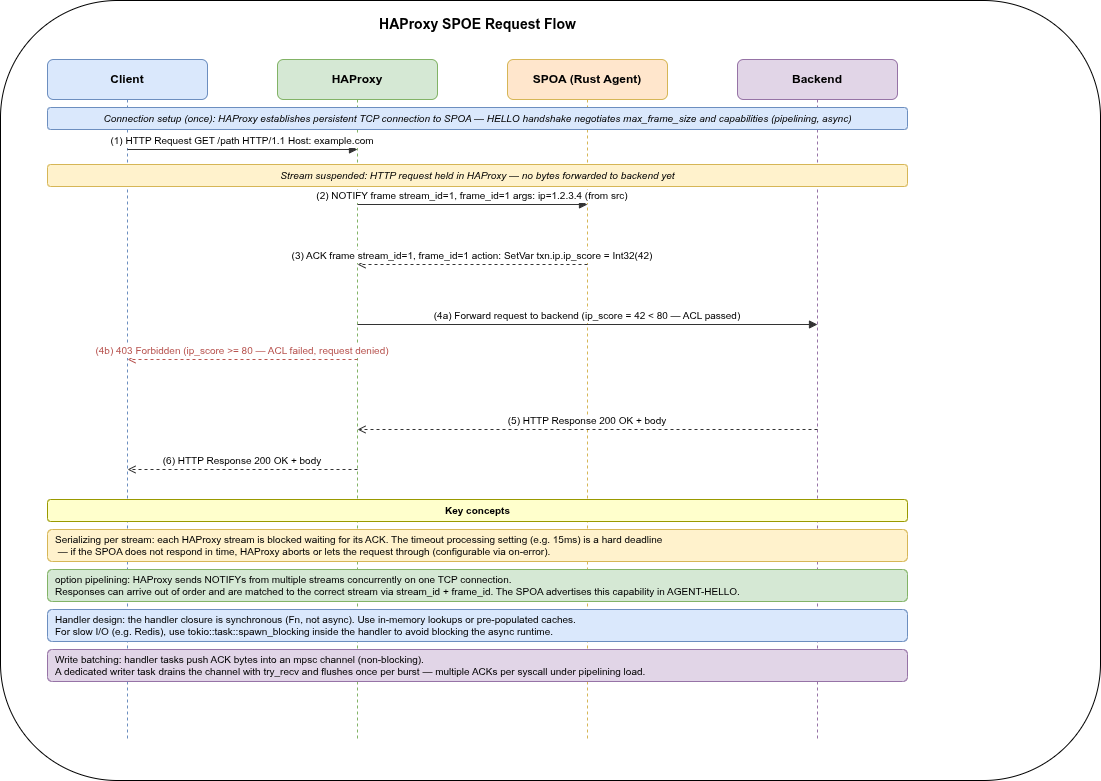
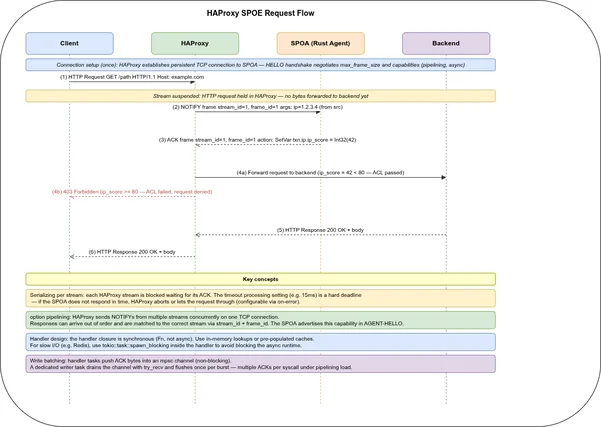
The diagram shows the six steps of a single request: the client sends a request (①), HAProxy suspends the stream and forwards a NOTIFY to the agent (②), the agent runs the handler and returns an ACK with variables (③), HAProxy resumes the stream and applies ACL rules (④), forwards to the backend (⑤), and returns the response (⑥). The annotated bands highlight where stream suspension, handler execution, write batching, and stream resumption occur.
HAProxy version compatibility. The library implements SPOP 2.0 and has been tested with HAProxy 2.9 and 3.x. The async capability advertised in older SPOE configs is ignored since HAProxy 3.x — only option pipelining is relevant.
HAProxy configuration🔗
A minimal SPOE setup looks like this:
# spoe filter in frontend
frontend http-in
    bind *:80
    filter spoe engine ip-reputation config /etc/haproxy/ip-reputation.conf
    http-request deny if { var(sess.ip.ip_score) -m int ge 80 }

# spoe config file
[ip-reputation]
spoe-agent ip-reputation
    messages         check-client-ip
    option           var-prefix ip
    timeout hello    100ms
    timeout idle     30s
    timeout processing 15ms
    use-backend      spoe-backend

spoe-message check-client-ip
    args ip=src
    event on-frontend-http-request

# backend pointing to the agent
backend spoe-backend
    mode tcp
    server spoa 127.0.0.1:9000
spoe-group: multiple messages per NOTIFY🔗
A spoe-group bundles several spoe-message entries and sends them all in one NOTIFY frame instead of one frame per message. Groups are not bound to a fixed event — they are triggered explicitly via TCP or HTTP rules, giving fine-grained control over when the SPOA is consulted (e.g. only for specific paths or content types).
From the agent’s perspective nothing changes: the NOTIFY payload is already a Vec<Message>, so a group simply means more entries in that list. The handler calls get_message() for each name it cares about:
Agent::new(|req| {
    if let Some(msg) = req.get_message("check-client-ip") { /* … */ }
    if let Some(msg) = req.get_message("check-user-agent") { /* … */ }
    // both arrive in the same req — one NOTIFY, two messages
})
HAProxy configuration using a group:
[my-engine]
spoe-agent my-agent
    groups   check-all          # reference the group, not individual messages
    option   var-prefix app
    timeout processing 15ms
    use-backend spoe-backend

spoe-group check-all
    messages check-client-ip check-user-agent

spoe-message check-client-ip
    args ip=src
    # no event — triggered by the group rule below

spoe-message check-user-agent
    args ua=req.hdr(user-agent)
# in the frontend — trigger the group only where needed
http-request send-spoe-group my-engine check-all
http-request deny if { var(txn.app.ip_score) -m int ge 80 }This is more efficient than two separate event-based messages when both checks are only needed for a subset of requests, because HAProxy sends a single NOTIFY carrying all arguments at once instead of two round-trips to the agent.
Processing model: serializing by design🔗
SPOE is fundamentally serializing per stream: when HAProxy encounters a filter spoe on a request, it suspends that stream — the HTTP request is held — sends a NOTIFY frame to the agent, and waits for the ACK before resuming. This is not a fire-and-forget side channel; it is a blocking call on the critical path of every request.
HAProxy stream          SPOA
     │                    │
     │──── NOTIFY ────────►│
     │     (suspended)     │  handler runs
     │◄─── ACK ───────────│
     │     (resumed)       │
Two consequences fall out of this immediately:
The handler must be fast.
timeout processingin the SPOE config is a hard deadline (15 ms in the example above). If the agent does not respond in time, HAProxy either aborts the request or lets it through, depending onon-errorsettings. This means handlers should be CPU-bound lookups against in-memory data, not synchronous database calls. For slow I/O, pre-populate a cache and consult it from the handler.Pipelining removes the per-stream bottleneck. Without it, a single SPOE TCP connection can only carry one NOTIFY/ACK exchange at a time. With
option pipelining, HAProxy sends NOTIFYs from many streams on the same connection without waiting for each ACK — the agent must correlate responses viastream_id/frame_id. The agent advertisescapabilities="pipelining"in its AGENT-HELLO to signal this support. (Theasynccapability that existed in older SPOE versions is deprecated and ignored by HAProxy since at least v3.x — onlypipeliningis relevant today.)
This is also why the write-batching in the architecture section matters: under pipelining, many NOTIFYs arrive in a burst and the agent must return ACKs quickly. The mpsc channel
try_recvloop ensures ACKs are batched into one syscall per burst rather than one syscall per frame.
Quick Start🔗
Add the library to Cargo.toml:
[dependencies]
haproxy-spoe = "1.0"
tokio = { version = "1", features = ["macros", "net"] }
The public API is a single closure passed to Agent::new:
use haproxy_spoe::{Agent, Scope, TypedData};
use tokio::net::TcpListener;

#[tokio::main]
async fn main() {
    let listener = TcpListener::bind("0.0.0.0:9000").await.unwrap();

    Agent::new(|req| {
        let Some(msg) = req.get_message("check-client-ip") else { return };
        let Some(TypedData::IPv4(ip)) = msg.get("ip") else { return };

        let score = if ip.octets()[0] == 10 { 100i32 } else { 0 };
        req.set_var(Scope::Session, "ip_score", TypedData::Int32(score));
    })
    .serve(listener)
    .await
    .unwrap();
}
The handler is a plain Fn(&mut Request) — synchronous, no async, no trait object boilerplate. req.set_var / req.unset_var build the ACK actions; the library handles framing, pipelining, healthchecks, and graceful disconnect.
For graceful shutdown (SIGTERM + Ctrl-C), tokio::select! on signal futures works naturally because Agent::serve is just an async function:
tokio::select! {
    res = agent.serve(listener) => res.expect("agent error"),
    _ = tokio::signal::ctrl_c() => {}
    _ = async {
        tokio::signal::unix::signal(SignalKind::terminate())
            .expect("signal handler")
            .recv().await
    } => {}
}
Real-world handler pattern🔗
The quick-start handler is intentionally minimal. In production the handler typically consults a shared in-memory data structure — an Arc<RwLock<…>> populated by a background refresh task:
use std::collections::HashSet;
use std::net::IpAddr;
use std::sync::{Arc, RwLock};

let blocklist: Arc<RwLock<HashSet<IpAddr>>> = Arc::new(RwLock::new(HashSet::new()));

// Background task: refresh blocklist from Redis / DB every 60 s.
let bl = Arc::clone(&blocklist);
tokio::spawn(async move {
    loop {
        let fresh = fetch_blocklist().await;
        *bl.write().unwrap() = fresh;
        tokio::time::sleep(std::time::Duration::from_secs(60)).await;
    }
});

// Handler: read-lock is cheap and contention-free under pipelining load.
let bl = Arc::clone(&blocklist);
Agent::new(move |req| {
    let Some(msg) = req.get_message("check-client-ip") else { return };
    let Some(TypedData::IPv4(ip)) = msg.get("ip") else { return };
    let blocked = blocklist.read().unwrap().contains(&IpAddr::V4(*ip));
    req.set_var(Scope::Session, "blocked", TypedData::Boolean(blocked));
})
.serve(listener)
.await?;
The RwLock read-lock is uncontended during normal operation because the background writer only holds it briefly during the swap. The handler never does I/O — it only reads from memory, which keeps it well inside the timeout processing budget.
Handler panics. If the handler panics, the tokio task for that NOTIFY is aborted and the ACK is never sent — HAProxy will hit timeout processing for that stream. The connection stays alive for all other streams. Panics are logged as worker errors via log::warn!. Prefer unwrap_or / ? patterns over unwrap() in handlers.
Environment variables🔗
The ip_reputation example is configured entirely through environment variables:
| Variable | Default | Description |
|---|---|---|
SPOE_ADDR | 0.0.0.0:9000 | TCP address the agent listens on |
TOKIO_WORKER_THREADS | number of CPU cores | Tokio async worker threads; read automatically by the runtime — no code change needed |
RUST_LOG | (logging off) | Log filter passed to env_logger, e.g. warn or haproxy_spoe=debug |
The agent prints its effective configuration at startup:
spoe agent listening on 0.0.0.0:9000
  TOKIO_WORKER_THREADS : 8
  RUST_LOG             : warn
What lives on the HAProxy side instead. Most operational tuning is done in the SPOE config, not in the agent:
| HAProxy directive | Effect |
|---|---|
timeout processing | Hard deadline per NOTIFY/ACK round-trip |
timeout idle | Idle connection keepalive |
maxconn on server entry | Max simultaneous connections to the agent |
maxconnrate | Max new connections per second |
Multiple server entries | Horizontal scaling — run N agent instances |
This clean separation means you can tune throughput and reliability entirely from HAProxy config without touching or redeploying the agent.
Dependencies🔗
The library has exactly three runtime dependencies:
| Crate | Role |
|---|---|
tokio (rt-multi-thread, net, io-util, sync, macros, signal, time) | Async I/O and task runtime |
mimalloc (default-features = false) | Global allocator for better multi-threaded allocation |
log = "0.4" | Logging facade — zero overhead when no subscriber is registered |
No serialization framework, no codec crate, no trait-heavy abstractions — the SPOE wire format is simple enough to implement directly.
Architecture🔗
Concurrency model🔗
TcpListener
    │
    ├─ tokio::spawn  (one task per connection)
    │       │
    │       ├─ reader loop  ──NOTIFY──►  JoinSet::spawn  (one task per frame)
    │       │                                   │
    │       │                               handler(&mut req)
    │       │                               tx.send(ack_bytes)   ◄── non-blocking
    │       │
    │       └─ writer task  (BufWriter, drains channel, one flush per batch)
    │               ▲
    │               └─ mpsc::unbounded_channel
The write path is the key design decision. An early version used Arc<Mutex<OwnedWriteHalf>> — every handler task locked the mutex, wrote its ACK, and unlocked. Under pipelining (HAProxy sends many NOTIFYs without waiting for ACKs), this caused per-ACK lock contention and one write syscall per frame.
The replacement is an mpsc::unbounded_channel<Vec<u8>> plus a dedicated writer task:
let (tx, mut rx) = mpsc::unbounded_channel::<Vec<u8>>();
let writer_task = tokio::spawn(async move {
    let mut writer = BufWriter::new(write_half);
    while let Some(bytes) = rx.recv().await {
        writer.write_all(&bytes).await?;
        // Drain everything queued before flushing — batch multiple ACKs per syscall.
        loop {
            match rx.try_recv() {
                Ok(more) => writer.write_all(&more).await?,
                Err(_) => break,
            }
        }
        writer.flush().await?;
    }
});
Handler tasks do tx.send(ack) — a non-blocking channel push, no await, no mutex. The writer task wakes once, drains with try_recv to collect all ACKs that arrived while it was writing, and issues a single flush. Multiple ACKs ship in one syscall.
InFrame enum🔗
Parsed inbound frames are typed enum variants — each carries exactly its own fields:
pub enum InFrame {
    HaproxyHello {
        stream_id: u64, frame_id: u64,
        engine_id: String,
        /// Comma-separated SPOP version list, e.g. `"2.0"`.
        supported_versions: String,
        max_frame_size: u32, healthcheck: bool,
    },
    HaproxyDisconnect {
        stream_id: u64, frame_id: u64,
        /// SPOE status code (0 = normal, 1 = I/O error, 2 = timeout, …).
        status_code: u32,
        message: String,
    },
    Notify { stream_id: u64, frame_id: u64, messages: Vec<Message> },
}
The worker uses an exhaustive match — the compiler enforces that all variants are handled, and there is no catch-all arm needed.
begin_frame / finish_frame (zero extra allocation)🔗
Encoding a response frame allocates one Vec<u8>:
// Reserve 4 zero bytes as length placeholder.
fn begin_frame(frame_type: u8, flags: u32, stream_id: u64, frame_id: u64) -> Vec<u8> { … }

// Patch the placeholder in-place once the full length is known.
fn finish_frame(mut out: Vec<u8>) -> Vec<u8> {
    let len = (out.len() - 4) as u32;
    out[0..4].copy_from_slice(&len.to_be_bytes());
    out
}
The previous design computed the header separately and then copied payload into a second Vec. finish_frame patches the 4-byte length field in-place — one allocation, no copy.
Protocol robustness🔗
A protocol implementation that only handles the happy path is incomplete. Four correctness points are worth calling out:
Version validation. The SPOE spec (§3.2.4) requires the agent to reject HAPROXY-HELLO if the supported-versions field is missing or contains no 2.x token. The library sends an AGENT-DISCONNECT with status 5 (“version value not found”) or 8 (“unsupported version”) and returns Error::Protocol — the connection never enters the ready state.
// worker.rs — rejects "1.0", accepts "2.0" and "2.0,1.0"
fn spop_version_supported(supported: &str) -> bool {
    !supported.is_empty()
        && supported.split(',').any(|v| v.trim().starts_with("2."))
}
HAPROXY-DISCONNECT payload. HAProxy can close a connection with a non-zero status code and human-readable message (status-code + message KV-LIST). These are now parsed into InFrame::HaproxyDisconnect and logged at warn level when non-zero, so connection problems are visible without needing a packet capture.
Unknown frame types → skip, not error. A future HAProxy version could introduce new frame types. Instead of disconnecting on an unrecognised type byte, the agent reads the frame body (the 4-byte length field is always present) and discards it, then continues. This forward compatibility costs nothing.
max_frame_size enforcement. The max-frame-size negotiated during HELLO is now enforced on every inbound frame before any buffer allocation. A peer claiming a 4 GB frame would previously cause an OOM; now it returns Error::Protocol immediately.
Logging🔗
The library uses the log facade. Two events are emitted at warn level:
- Worker errors (protocol violation, I/O error on a connection) — in
Agent::serve - HAProxy sending DISCONNECT with a non-zero status code
When no subscriber is registered the macros compile to nothing — zero runtime overhead. To enable logging in your application add a subscriber of your choice:
// Cargo.toml: env_logger = "0.11"
env_logger::init(); // RUST_LOG=warn ./your-agent
or with tracing:
// Cargo.toml: tracing-subscriber = { version = "0.3", features = ["env-filter"] }
tracing_subscriber::fmt::init();
SPOE wire format essentials🔗
The protocol is compact and straightforward:
| Field | Size | Notes |
|---|---|---|
| Frame length | 4 bytes BE | counts everything after itself |
| Frame type | 1 byte | 0x01 HAPROXY-HELLO, 0x03 NOTIFY, 0x65 AGENT-HELLO, 0x67 ACK … |
| Flags | 4 bytes BE | bit 0 = FIN |
| Stream ID | varint | |
| Frame ID | varint | |
| Payload | variable | type-specific KV or message list |
Varint uses the SPOE Peers encoding: values < 240 fit in 1 byte; larger values use continuation bytes with the formula (n-128) >> 7 (not the more common n >> 7).
TypedData encodes the type in the lower nibble and flags in the upper nibble of the first byte. Integers are encoded as varints, not fixed-width. bool true = 0x11, bool false = 0x01.
Module layout🔗
After splitting the three largest files (each was 250–464 lines) using the Rust 2018 module system (src/foo.rs + src/foo/submod.rs, no mod.rs needed):
src/
  lib.rs               # global_allocator + public re-exports
  error.rs             # Error enum
  varint.rs            # SPOE Peers varint encode/decode
  typeddata.rs         # TypedData enum + encode(); declares mod decode
  typeddata/
    decode.rs          # impl TypedData { pub fn decode() } + all decode tests
  action.rs            # Action enum (SetVar/UnsetVar), Scope enum
  message.rs           # Message struct
  frame.rs             # FrameType, InFrame enum, encode_agent_*; declares mod parse
  frame/
    parse.rs           # parse() + parse helpers + parse tests
  request.rs           # Request with set_var/unset_var helpers
  worker.rs            # async TCP handler; declares mod util, writer, tests
  worker/
    writer.rs          # spawn_writer(): BufWriter batching task
    util.rs            # spop_version_supported, broken_pipe, drain,
                       #   is_connection_close + unit tests
    tests.rs           # 12 tokio TCP integration tests + wire helpers
  agent.rs             # Agent::new(handler).serve(TcpListener)
examples/
  ip_reputation.rs     # complete working example (SIGTERM + Ctrl-C)
  bench.rs             # throughput benchmark (fake HAProxy, pipelined NOTIFYs)
tests/
  spoe_agent.vtc       # VTest end-to-end test (real HAProxy + Rust agent)
impl TypedData blocks may live in any module within the same crate, so decode.rs adds the decode() method from the submodule without any re-export gymnastics. The worker submodules use Rust 2018 path conventions (src/worker/writer.rs etc.) — no mod.rs needed, and pub(super) visibility keeps each helper scoped to the worker module.
Testing and coverage🔗
65 tests in total, exercising the library at multiple levels:
| Test location | Count | What it tests |
|---|---|---|
typeddata::decode::tests | 9 | roundtrip encode/decode for all types + error paths |
frame::parse::tests | 16 | parse happy paths + malformed input + disconnect payload + supported-versions |
frame::tests | 4 | encode correctness |
worker::tests (in worker/tests.rs) | 12 | full TCP integration: hello/notify/disconnect, healthcheck, protocol errors, version rejection, unknown frame skip, oversized frame, EOF mid-frame, agent-sent frame type skip, non-zero DISCONNECT status |
worker::util::tests | 2 | is_connection_close logic |
agent::tests | 2 | is_transient logic |
other inline mod tests | ~20 | varint, action, message, request, error |
The integration tests in worker/tests.rs spin up a real TcpListener and exchange raw SPOE frames over TCP — no mocks, no stubs.
Combined line coverage via cargo llvm-cov + VTest (real HAProxy against the ip_reputation example):
| Module | Lines | Coverage |
|---|---|---|
| action.rs | 63 | 100% |
| error.rs | 50 | 100% |
| frame.rs + frame/parse.rs | 309 | 97.7% |
| message.rs | 31 | 100% |
| request.rs | 69 | 100% |
| typeddata.rs + typeddata/decode.rs | 138 | 100% |
| varint.rs | 78 | 99.1% |
| worker.rs + worker_tests.rs | 304 | 93.1% |
| agent.rs | 43 | 79.1% |
| Total | 1140 | 95.9% |
The agent.rs gap is the accept-error branch (lines 36–41) — exercising it requires a real failing listener and is not worth the complexity.
VTest end-to-end test🔗
tests/spoe_agent.vtc runs a real HAProxy instance against the compiled ip_reputation binary. A few non-obvious constraints when writing VTest scripts for SPOE:
- Process names must start with
p:process foomust beprocess p_foo. - VTest does not propagate environment variables to child processes — set them inside the command string.
option pipeliningmust be present in the SPOE agent config for HTTP/1.1 keepalive reuse.process -stopuses SIGKILL (kill(-pid, 9)) —atexitnever runs, the profraw file stays at 0 bytes. Manage the agent viashellblocks andkill -TERMinstead.
Throughput: Rust vs Go🔗
How bench.rs works🔗
examples/bench.rs is self-contained — it starts the ip_reputation agent in-process on a random port, then immediately acts as a fake HAProxy client on the same machine:
let listener = TcpListener::bind("127.0.0.1:0").await.unwrap();
let addr = listener.local_addr().unwrap();
tokio::spawn(async move { agent.serve(listener).await.unwrap(); });
After the HAPROXY-HELLO / AGENT-HELLO handshake, each connection does exactly what a pipelining HAProxy does: concatenate all NOTIFY frames into one buffer and send them in a single write_all, then read ACKs one by one until all are received. The clock runs from the first send to the last ACK.
// Pipeline: send all NOTIFYs in one write, then drain ACKs
let mut all_notifies = Vec::with_capacity(frames as usize * 32);
for i in 1..=frames {
    all_notifies.extend_from_slice(&wire_frame(0x03, 1, i, i, notify_payload));
}
stream.write_all(&all_notifies).await.unwrap();

for _ in 0..frames {
    stream.read_exact(&mut ack_buf).await.unwrap();
    // …read body…
}
Run it with:
cargo run --release --example bench -- [FRAMES] [CONNECTIONS]
# defaults: 100_000 frames, 1 connection
Example output:
Benchmarking 200000 NOTIFY frames over 1 connection(s) (200000 each)…
Done in 0.291s → 687241 frames/s (1.46 µs/frame)Results🔗
| Config | Rust | Go | Speedup |
|---|---|---|---|
| 1 connection, 200k frames | ~687k fps | ~244k fps | ~2.8× |
| 4 connections, 1M frames | ~1.74M fps | ~354k fps | ~4.9× |
Why Rust wins — and why the gap grows with connections🔗
The Go bottleneck is the write path: each handler goroutine calls conn.Write() directly, so every ACK is a separate syscall. Under pipelining, with many NOTIFYs queued at once, this means N goroutines each waking, locking the connection, and issuing one write — no batching.
The Rust writer task drains the mpsc channel with try_recv and issues a single flush() per burst. Under heavy pipelining dozens of ACKs ship in one syscall. With more connections the batching benefit compounds: the tokio scheduler keeps all threads busy and the combined throughput grows super-linearly, while the Go agent’s per-connection write contention stays constant.
The Go benchmark lives in cmd/bench/main.go of haproxy-spoe-go and uses the same payload (IPv4 ip argument), the same pipelining strategy, and the same measurement window.
Comparison with spop🔗
There is one other Rust SPOE crate: spop (GitHub: nbari/spop, v0.11.0, March 2026).
spop | haproxy-spoe-rs | |
|---|---|---|
| Level | Protocol codec (SpopCodec, SpopFrame trait) | High-level agent framework |
| API | Frames manually handled | Agent::new(handler).serve(listener) |
| Extra deps | tokio-util | none beyond tokio |
spop is a frame-level codec — connection state (hello handshake, pipelining, ACK routing) must be managed by the caller. haproxy-spoe-rs abstracts all of that away so you write only the handler logic.