haproxy-spoe-rs: Deployment
Table of contents
This post covers deploying the haproxy-spoe-rs SPOA agent in production. It is a companion to the architecture post which explains the library design.
The agent and HAProxy run as separate services — HAProxy connects to the agent over TCP. This keeps their lifecycles independent and allows scaling each side separately.
Building the container image🔗
The repository includes a two-stage Containerfile: the builder stage compiles the ip_reputation example with --release, the runtime stage copies the binary into a minimal debian:bookworm-slim image.
podman build -f Containerfile -t spoe-agent:latest .The image runs as any UID — no USER directive is set, which makes it compatible with OpenShift’s default restricted security context.
Quick smoke test:
podman run --rm -e SPOE_ADDR=0.0.0.0:9000 -p 9000:9000 spoe-agent:latestExpected output:
spoe agent listening on 0.0.0.0:9000
  TOKIO_WORKER_THREADS : 4
RUST_LOG : offpodman-compose🔗
The following setup runs HAProxy and the SPOE agent as separate services. HAProxy connects to the agent by service name (spoe-agent:9000) over the compose network.
Config files🔗
haproxy.cfg
global
    log stdout format raw local0

defaults
    log     global
    mode    http
    option  httplog
    timeout connect   5s
    timeout client   30s
    timeout server   30s

frontend http-in
    bind *:80
    filter spoe engine rate-limit config /etc/haproxy/rate-limit.conf
    http-request deny deny_status 429 if { var(sess.rl.ip_score) -m int ge 80 }
    default_backend web

backend web
    server s1 web:80

backend spoe-backend
    mode tcp
    server spoa spoe-agent:9000 check inter 5s

listen stats
    bind *:8404
    stats enable
    stats uri /stats
    stats refresh 10s
rate-limit.conf
[rate-limit]
spoe-agent rate-limit
    messages         check-rate
    option           var-prefix rl
    option           pipelining
    timeout hello    100ms
    timeout idle     30s
    timeout processing 15ms
    use-backend      spoe-backend

spoe-message check-rate
    args ip_fwd=req.hdr(Forwarded),rfc7239_field(for),rfc7239_n2nn
    args ip_xff=req.hdr_ip(X-Forwarded-For,1)
    args ip_src=src
    event on-frontend-http-request
SPOE filter ordering: HAProxy runs SPOE filters before
http-requestrules — this is hardcoded in the stream processing loop and cannot be changed by moving thefilterdirective in the config. Variables set withhttp-request set-varare not yet available when the SPOE message is assembled; they arrive asNullin the agent.Source proof (HAProxy 3.3.6): The
FLT_ANALYZEmacro insrc/stream.calways callsflt_pre_analyze()before the analyzer function. SPOE registers onAN_REQ_HTTP_PROCESS_FEas a pre-analyzer (src/flt_spoe.c:1353);http-requestrules run insidehttp_process_req_commonwhich executes after all pre-analyzers (src/http_ana.c:414).Solution: use sample fetches directly in
args— they are evaluated at filter fire time. The three args above pass RFC 7239, XFF, and TCP src as separate values; the agent resolves the priority chain (Forwarded → XFF → src) viafind_map.
compose file🔗
services:
  haproxy:
    image: haproxytech/haproxy-ubuntu:3.3
    ports:
      - "80:80"
      - "8404:8404"
    volumes:
      - ./haproxy.cfg:/usr/local/etc/haproxy/haproxy.cfg:ro
      - ./rate-limit.conf:/etc/haproxy/rate-limit.conf:ro
    depends_on:
      - spoe-agent

  spoe-agent:
    image: spoe-agent:latest
    environment:
      SPOE_ADDR: "0.0.0.0:9000"
      TOKIO_WORKER_THREADS: "4"
      RUST_LOG: "warn"
Start:
podman-compose up -dKubernetes🔗
The agent runs as a Deployment with its own Service. HAProxy resolves the agent via the cluster DNS name spoe-agent:9000. The HAProxy config and SPOE config are provided via ConfigMap.
SPOE agent🔗
apiVersion: apps/v1
kind: Deployment
metadata:
  name: spoe-agent
spec:
  replicas: 2
  selector:
    matchLabels:
      app: spoe-agent
  template:
    metadata:
      labels:
        app: spoe-agent
    spec:
      containers:
        - name: spoe-agent
          image: spoe-agent:latest
          ports:
            - containerPort: 9000
          env:
            - name: SPOE_ADDR
              value: "0.0.0.0:9000"
            - name: RUST_LOG
              value: "warn"
            - name: TOKIO_WORKER_THREADS
              value: "4"
          resources:
            requests:
              cpu: "250m"
              memory: "64Mi"
            limits:
              cpu: "1"
              memory: "128Mi"
---
apiVersion: v1
kind: Service
metadata:
  name: spoe-agent
spec:
  selector:
    app: spoe-agent
  ports:
    - port: 9000
      targetPort: 9000
The container runs as any UID and does not require elevated privileges — it is compatible with the Kubernetes restricted Pod Security Standard and OpenShift’s default SCC without any additional configuration.
TOKIO_WORKER_THREADS should match the CPU limit to avoid creating more threads than the scheduler will run. With a limit of 1, set TOKIO_WORKER_THREADS=1; with 2, set it to 2.
HAProxy🔗
apiVersion: v1
kind: ConfigMap
metadata:
  name: haproxy-config
data:
  haproxy.cfg: |
    global
        log stdout format raw local0
    defaults
        log     global
        mode    http
        option  httplog
        timeout connect   5s
        timeout client   30s
        timeout server   30s
    frontend http-in
        bind *:80
        filter spoe engine rate-limit config /etc/haproxy/rate-limit.conf
        http-request deny deny_status 429 if { var(sess.rl.ip_score) -m int ge 80 }
        default_backend web
    backend web
        server s1 web:80
    backend spoe-backend
        mode tcp
        server spoa spoe-agent:9000 check inter 5s
  rate-limit.conf: |
    [rate-limit]
    spoe-agent rate-limit
        messages         check-rate
        option           var-prefix rl
        option           pipelining
        timeout hello    100ms
        timeout idle     30s
        timeout processing 15ms
        use-backend      spoe-backend
    spoe-message check-rate
        args ip_fwd=req.hdr(Forwarded),rfc7239_field(for),rfc7239_n2nn
        args ip_xff=req.hdr_ip(X-Forwarded-For,1)
        args ip_src=src
        event on-frontend-http-request
---
apiVersion: apps/v1
kind: Deployment
metadata:
  name: haproxy
spec:
  replicas: 1
  selector:
    matchLabels:
      app: haproxy
  template:
    metadata:
      labels:
        app: haproxy
    spec:
      containers:
        - name: haproxy
          image: haproxytech/haproxy-ubuntu:3.3
          ports:
            - containerPort: 80
            - containerPort: 8404
          volumeMounts:
            - name: config
              mountPath: /usr/local/etc/haproxy/haproxy.cfg
              subPath: haproxy.cfg
            - name: config
              mountPath: /etc/haproxy/rate-limit.conf
              subPath: rate-limit.conf
      volumes:
        - name: config
          configMap:
            name: haproxy-config
---
apiVersion: v1
kind: Service
metadata:
  name: haproxy
spec:
  selector:
    app: haproxy
  ports:
    - name: http
      port: 80
      targetPort: 80
    - name: stats
      port: 8404
      targetPort: 8404
HAProxy backend configuration🔗
A few directives on the spoe-backend that matter in production:
backend spoe-backend
    mode tcp
    server spoa spoe-agent:9000 check inter 5s   # TCP health check every 5 s
server spoa2 spoe-agent2:9000 check inter 5s # second instance for redundancy| Directive | Where | Effect |
|---|---|---|
check inter 5s | server | TCP health check interval — removes failed agents automatically |
maxconn N | server | Max simultaneous connections per agent instance |
timeout processing | SPOE config | Hard deadline per NOTIFY/ACK — tune to your handler latency |
timeout idle | SPOE config | Keepalive for idle SPOE connections |
option pipelining | SPOE config | Required for high throughput — sends multiple NOTIFYs without waiting for ACKs |
Health checking🔗
The SPOE protocol has a built-in healthcheck: when HAProxy opens a connection for checking, it sends HAPROXY-HELLO with healthcheck=true. The agent replies with AGENT-HELLO and closes the connection immediately. This is handled by the library — no code needed in the handler.
The check inter 5s on the server line triggers a TCP connection which exercises this path. If the agent does not respond, HAProxy marks the server down and stops sending NOTIFYs to it.
Logging and observability🔗
The agent uses the log facade. Enable it by setting RUST_LOG:
| Value | Effect |
|---|---|
off (default) | No output |
warn | Connection errors and non-zero DISCONNECT status |
haproxy_spoe=debug | Protocol-level events (not recommended in production) |
HAProxy’s own logging covers request-level events — whether a stream was denied based on the ip_score variable set by the agent is visible in the HAProxy access log.
Distributed GCRA rate limiting with Valkey🔗
The basic example above assigns a static score per IP. In production you often need actual rate limiting — count real requests, allow controlled bursts, and keep state consistent across all agent replicas.
GCRA (Generic Cell Rate Algorithm) stores a theoretical arrival time (TAT) per client and updates it atomically on every request. When the agent runs as multiple replicas, that state must live in a shared external store.
Valkey (Linux Foundation Redis fork, BSD-3-Clause) fills that role. Valkey Cluster distributes hash slots across nodes — active-active — and AOF persistence ensures state survives pod restarts.
A fully deployable example — standalone Rust crate, Kustomize manifests for Kubernetes and OpenShift, and ArgoCD
Applicationobjects — lives inexamples/GCRA-Rate-Limiting/in the repository.
Topology🔗
| Component | Replicas | State | Persistence |
|---|---|---|---|
| HAProxy | 3 | Stateless | — |
| spoe-agent | 3 | Stateless | — |
| Valkey Cluster | 3 | Stateful (TAT per IP) | AOF (everysec) |
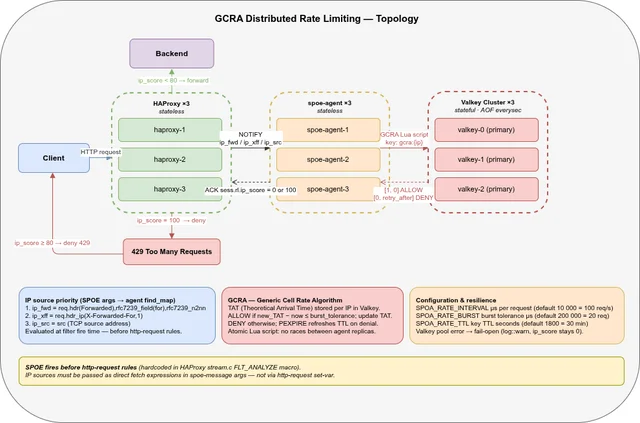
All three tiers are stateless except Valkey. A given client IP’s TAT key maps to exactly one Valkey primary — GCRA correctness is guaranteed regardless of which agent or HAProxy instance handles the request.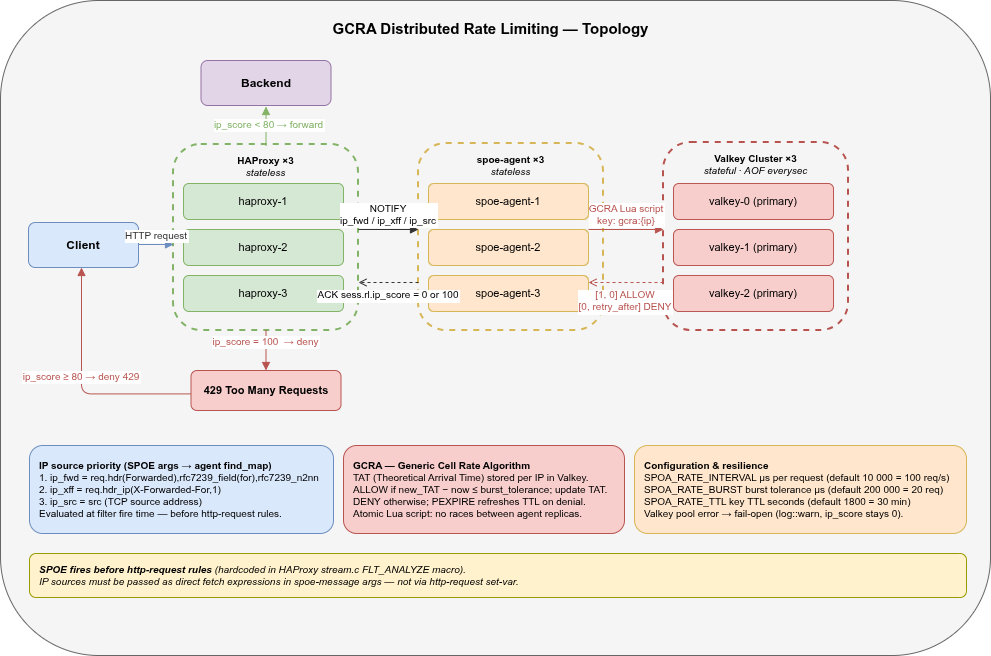
The request flows left to right. HAProxy holds the HTTP stream and sends a SPOE NOTIFY with three IP args (ip_fwd, ip_xff, ip_src) — evaluated directly at filter fire time. The agent resolves the priority chain (RFC 7239 Forwarded → X-Forwarded-For → TCP src) and runs the GCRA Lua script against Valkey. Valkey returns [1, 0] (allow) or [0, retry_after_µs] (deny); the agent writes sess.rl.ip_score = 0 or 100 into the ACK. HAProxy resumes the stream: ip_score < 80 forwards to the backend, ip_score ≥ 80 returns 429.
Only Valkey carries state — HAProxy and the spoe-agent are fully stateless and scale horizontally without coordination. A given IP’s GCRA key always maps to the same Valkey primary via hash-slot routing, so GCRA correctness is guaranteed across all replicas.
Valkey Cluster🔗
valkey-cluster.yaml
apiVersion: v1
kind: ConfigMap
metadata:
  name: valkey-config
data:
  valkey.conf: |
    cluster-enabled yes
    cluster-config-file /data/nodes.conf
    cluster-node-timeout 5000
    appendonly yes
    appendfsync everysec
    protected-mode no
    bind 0.0.0.0
---
apiVersion: v1
kind: Service
metadata:
  name: valkey-headless
spec:
  clusterIP: None
  selector:
    app: valkey
  ports:
    - name: client
      port: 6379
    - name: gossip
      port: 16379
---
apiVersion: v1
kind: Service
metadata:
  name: valkey
spec:
  selector:
    app: valkey
  ports:
    - port: 6379
      targetPort: 6379
---
apiVersion: apps/v1
kind: StatefulSet
metadata:
  name: valkey
spec:
  serviceName: valkey-headless
  replicas: 3
  selector:
    matchLabels:
      app: valkey
  template:
    metadata:
      labels:
        app: valkey
    spec:
      containers:
        - name: valkey
          image: valkey/valkey:8.1
          command:
            - valkey-server
            - /etc/valkey/valkey.conf
            - --cluster-announce-hostname
            - $(POD_NAME).valkey-headless.$(NAMESPACE).svc.cluster.local
          env:
            - name: POD_NAME
              valueFrom:
                fieldRef:
                  fieldPath: metadata.name
            - name: NAMESPACE
              valueFrom:
                fieldRef:
                  fieldPath: metadata.namespace
          ports:
            - containerPort: 6379
            - containerPort: 16379
          volumeMounts:
            - name: config
              mountPath: /etc/valkey
            - name: data
              mountPath: /data
          resources:
            requests:
              cpu: "250m"
              memory: "128Mi"
            limits:
              cpu: "1"
              memory: "256Mi"
      volumes:
        - name: config
          configMap:
            name: valkey-config
  volumeClaimTemplates:
    - metadata:
        name: data
      spec:
        accessModes: ["ReadWriteOnce"]
        resources:
          requests:
            storage: 1Gi
After all three pods are Running, initialize the cluster once:
kubectl exec valkey-0 -- valkey-cli --cluster create \
  valkey-0.valkey-headless:6379 \
  valkey-1.valkey-headless:6379 \
  valkey-2.valkey-headless:6379 \
  --cluster-replicas 0 --cluster-yes
OpenShift note:
valkey/valkey:8.1runs as UID 999. OpenShift’s restricted SCC assigns a random UID from the namespace range. AddsecurityContext: { runAsUser: null }to the container spec to let OpenShift assign the UID.
GCRA handler🔗
Add the redis and r2d2 crates to Cargo.toml:
redis = { version = "0.27", features = ["cluster"] }
r2d2   = "0.8"
r2d2_redis only wraps the single-node client, so we implement the pool manager for ClusterClient ourselves — it is a small struct.
The GCRA algorithm runs as a Lua script inside Valkey rather than in Rust for one fundamental reason: atomicity. A read-modify-write sequence in Rust — GET the TAT, compute the new TAT, SET it back — would require a WATCH/MULTI/EXEC transaction or a Redlock-style distributed lock to be safe under concurrent access from multiple agent replicas. Both approaches add round-trips and complexity.
A Lua script uploaded to Valkey executes as a single atomic unit: no other client can observe or modify the key between the GET and the SET. This is a Redis/Valkey guarantee: scripts run under the single-threaded command processor, so the entire GCRA decision is serialized per key without any locking overhead on the client side.
Performance is not a concern. Valkey (like Redis) embeds LuaJIT — the script is compiled to native code on first load and cached by its SHA1 digest. Subsequent calls via redis::Script skip the compilation step entirely. The script itself is five arithmetic operations and two conditional SET/PEXPIRE calls — it completes in microseconds, well within the timeout processing 15ms budget configured in the SPOE agent section.
The script executes atomically, so no two agent instances can race on the same key:
use haproxy_spoe::{Agent, Scope, TypedData};
use redis::cluster::{ClusterClient, ClusterConnection};
use std::sync::Arc;
use std::time::{SystemTime, UNIX_EPOCH};
use tokio::net::TcpListener;

// r2d2 connection pool manager for Valkey Cluster.
struct ClusterManager(ClusterClient);

impl r2d2::ManageConnection for ClusterManager {
    type Connection = ClusterConnection;
    type Error = redis::RedisError;

    fn connect(&self) -> Result<Self::Connection, Self::Error> {
        self.0.get_connection()
    }

    fn is_valid(&self, conn: &mut Self::Connection) -> Result<(), Self::Error> {
        redis::cmd("PING").query(conn)
    }

    fn has_broken(&self, _: &mut Self::Connection) -> bool {
        false
    }
}

// GCRA via atomic Lua script.
// KEYS[1] = TAT key  ARGV[1] = now (µs)  ARGV[2] = emission_interval (µs)
//           ARGV[3] = burst_tolerance (µs)  ARGV[4] = ttl (ms)
// Returns [1, 0] = allowed, [0, retry_after_µs] = denied.
const GCRA_SCRIPT: &str = r#"
local tat = tonumber(redis.call('GET', KEYS[1]))
local now = tonumber(ARGV[1])
local ei  = tonumber(ARGV[2])
local bt  = tonumber(ARGV[3])
local ttl = tonumber(ARGV[4])
if tat == nil or tat < now then tat = now end
local new_tat = tat + ei
if new_tat - now > bt then
    -- Refresh TTL on denial so the key does not expire while the client
    -- is actively being rate-limited (prevents a free burst after expiry).
    redis.call('PEXPIRE', KEYS[1], ttl)
    return {0, new_tat - now}
end
redis.call('SET', KEYS[1], new_tat, 'PX', ttl)
return {1, 0}
"#;

#[tokio::main]
async fn main() -> Result<(), Box<dyn std::error::Error>> {
    env_logger::Builder::from_default_env()
        .target(env_logger::Target::Stdout)
        .init();

    let nodes: Vec<String> = std::env::var("VALKEY_NODES")
        .unwrap_or_else(|_| "redis://valkey-0.valkey-headless:6379".into())
        .split(',')
        .map(|s| s.trim().to_string())
        .collect();

    let pool_size = std::env::var("TOKIO_WORKER_THREADS")
        .ok()
        .and_then(|v| v.parse::<u32>().ok())
        .unwrap_or(16);

    // build_unchecked: no connections opened at startup — first attempt happens
    // on the first incoming request. Avoids noisy r2d2 ERROR logs when Valkey
    // is not yet reachable during pod startup.
    let pool = Arc::new(
        r2d2::Pool::builder()
            .max_size(pool_size)
            .min_idle(Some(0))
            .build_unchecked(ClusterManager(ClusterClient::new(nodes)?)),
    );

    let emission_interval_us: i64 = std::env::var("SPOA_RATE_INTERVAL")
        .ok()
        .and_then(|v| v.parse::<i64>().ok())
        .unwrap_or(10_000); // 10 ms = 1 / 100 req/s

    let burst_tolerance_us: i64 = std::env::var("SPOA_RATE_BURST")
        .ok()
        .and_then(|v| v.parse::<i64>().ok())
        .unwrap_or(200_000); // 200 ms = 20 burst requests

    let ttl_ms: i64 = std::env::var("SPOA_RATE_TTL")
        .ok()
        .and_then(|v| v.parse::<i64>().ok())
        .unwrap_or(1800) * 1000;

    let addr = std::env::var("SPOE_ADDR").unwrap_or_else(|_| "0.0.0.0:9000".into());
    let listener = TcpListener::bind(&addr).await?;

    let workers = std::env::var("TOKIO_WORKER_THREADS")
        .ok()
        .and_then(|v| v.parse::<usize>().ok())
        .unwrap_or_else(|| std::thread::available_parallelism().map(|n| n.get()).unwrap_or(1));
    println!("gcra-rate-limit listening on {addr}");
    println!("  TOKIO_WORKER_THREADS  : {workers}");
    println!("  SPOA_RATE_TTL         : {}s", ttl_ms / 1000);
    println!("  SPOA_RATE_INTERVAL    : {}µs (= {:.0} req/s)", emission_interval_us, 1_000_000.0 / emission_interval_us as f64);
    println!("  SPOA_RATE_BURST       : {}µs (= {} req burst)", burst_tolerance_us, burst_tolerance_us / emission_interval_us);

    let agent = Agent::new(move |req| {
        let Some(msg) = req.get_message("check-rate") else { return };
        // Priority: RFC 7239 Forwarded > X-Forwarded-For > TCP src.
        // SPOE filters run before http-request rules, so all three sources
        // are passed as separate args and resolved here.
        let ip = ["ip_fwd", "ip_xff", "ip_src"].iter().find_map(|arg| {
            match msg.get(arg) {
                Some(TypedData::IPv4(ip)) => Some(ip.to_string()),
                Some(TypedData::IPv6(ip)) => Some(ip.to_string()),
                _ => None,
            }
        });
        let Some(ip) = ip else { return };
        let sid = req.stream_id;

        let key = format!("gcra:{ip}");
        let now = SystemTime::now()
            .duration_since(UNIX_EPOCH)
            .unwrap()
            .as_micros() as i64;

        let mut conn = match pool.get() {
            Ok(c) => c,
            Err(e) => {
                log::warn!("valkey pool unavailable, failing open: {e}");
                return;
            }
        };
        let result: Option<Vec<i64>> = redis::Script::new(GCRA_SCRIPT)
            .key(&key)
            .arg(now)
            .arg(emission_interval_us)
            .arg(burst_tolerance_us)
            .arg(ttl_ms)
            .invoke(&mut *conn)
            .ok();

        let denied = result.as_ref().map(|v| v[0] == 0).unwrap_or(false);

        if denied {
            let retry_us = result.as_ref().map(|v| v[1]).unwrap_or(0);
            log::debug!("stream={sid} DENY  {ip}  retry_after={:.1}ms", retry_us as f64 / 1000.0);
        } else {
            log::debug!("stream={sid} ALLOW {ip}");
        }

        req.set_var(
            Scope::Session,
            "ip_score",
            TypedData::Int32(if denied { 100 } else { 0 }),
        );
    });

    let mut sigterm = tokio::signal::unix::signal(tokio::signal::unix::SignalKind::terminate())
        .expect("failed to register SIGTERM handler");

    tokio::select! {
        res = agent.serve(listener) => res?,
        _ = tokio::signal::ctrl_c() => {}
        _ = sigterm.recv() => {}
    }

    Ok(())
}
Rate parameters — all configurable via environment variables:
| Env var | Default | Meaning |
|---|---|---|
SPOA_RATE_INTERVAL | 10000 µs | Emission interval: 1 000 000 / rate_per_second |
SPOA_RATE_BURST | 200000 µs | Burst tolerance: burst_size × SPOA_RATE_INTERVAL |
SPOA_RATE_TTL | 1800 s | How long an IP is remembered in Valkey after last request |
Example: 50 req/s sustained, burst of 10:
SPOA_RATE_INTERVAL=20000   # 1 000 000 / 50 = 20 ms
SPOA_RATE_BURST=200000     # 10 × 20 ms = 200 ms
pool_size is read from TOKIO_WORKER_THREADS so each worker thread can hold its own connection without waiting. Each pool.get() call checks out a connection for the duration of the handler invocation and returns it automatically when it goes out of scope.
SPOA Deployment (3 replicas)🔗
apiVersion: apps/v1
kind: Deployment
metadata:
  name: spoe-agent
spec:
  replicas: 3
  selector:
    matchLabels:
      app: spoe-agent
  template:
    metadata:
      labels:
        app: spoe-agent
    spec:
      containers:
        - name: spoe-agent
          image: spoe-agent:latest
          ports:
            - containerPort: 9000
          env:
            - name: SPOE_ADDR
              value: "0.0.0.0:9000"
            - name: RUST_LOG
              value: "warn"
            - name: TOKIO_WORKER_THREADS
              value: "2"
            - name: VALKEY_NODES
              value: "redis://valkey-0.valkey-headless:6379,redis://valkey-1.valkey-headless:6379,redis://valkey-2.valkey-headless:6379"
            - name: SPOA_RATE_TTL
              value: "1800"
            - name: SPOA_RATE_INTERVAL
              value: "10000"
            - name: SPOA_RATE_BURST
              value: "200000"
          resources:
            requests:
              cpu: "250m"
              memory: "64Mi"
            limits:
              cpu: "1"
              memory: "128Mi"
HAProxy load-balances the three agents via the spoe-agent ClusterIP Service. No sticky routing is needed.
HAProxy (3 replicas)🔗
Set replicas: 3 in the HAProxy Deployment from the Kubernetes section. No other changes are needed — each HAProxy instance connects to the same spoe-agent Service.
GitOps deployment with ArgoCD🔗
The examples/GCRA-Rate-Limiting/ directory contains everything needed to deploy the full stack with ArgoCD:
examples/GCRA-Rate-Limiting/
├── Cargo.toml                         standalone crate (path dep on library)
├── Containerfile                      two-stage build, build context = repo root
├── src/main.rs                        GCRA handler with r2d2, IPv4+IPv6, signals
├── kubernetes/
│   ├── base/                          namespace-agnostic manifests + kustomization.yaml
│   ├── overlays/
│   │   ├── kubernetes/                sets namespace, image tag
│   │   └── openshift/                 + Route + runAsUser: null patch for HAProxy
│   └── valkey/values.yaml             Helm values for valkey-io/valkey-helm
└── argocd/
    ├── application-spoe.yaml          Kustomize app (switch overlay via comment)
    └── application-valkey.yaml        multi-source: Helm chart + values from this repo
The Valkey Application uses ArgoCD’s multi-source pattern: the Helm chart comes from the valkey-io/valkey-helm repository while values.yaml is read from this repository, pinned to main:
sources:
  - repoURL: https://valkey-io.github.io/valkey-helm
    chart: valkey
    targetRevision: "1.*"
    helm:
      valueFiles:
        - $values/examples/GCRA-Rate-Limiting/kubernetes/valkey/values.yaml
  - repoURL: https://github.com/git001/haproxy-spoe-rs.git
    targetRevision: main
    ref: values
To deploy on vanilla Kubernetes, apply both Application objects:
kubectl apply -f examples/GCRA-Rate-Limiting/argocd/For OpenShift, edit application-spoe.yaml and switch the path to overlays/openshift before applying.