Envoy Gateway v1.7: Global Rate Limiting with a Custom ratelimit Service
Global rate limiting in Envoy Gateway (EG) can be set up in two ways: the easy path (EG manages its own envoy-ratelimit container) and the flexible path (you bring your own envoyproxy/ratelimit service). This post covers the flexible path — Option B — and documents the three xDS patches required to wire it up, the EG v1.7 breaking changes that affect the approach, and a namespace-admin self-service deployment model.
Why Rate Limiting in Production🔗
Every public-facing API eventually attracts traffic it wasn’t designed for: scrapers that ignore backoff hints, misconfigured clients retrying in tight loops, credential-stuffing bots working through a list, or just a single user whose code went wrong and fires 10 000 requests in a minute. Without a rate limit, all of that hits your backend — and the backend has no way to distinguish it from legitimate traffic until it’s already under load.
Global rate limiting addresses this at the proxy layer, before the request reaches any application code:
- Protect backend capacity. A sudden spike — intentional or not — is absorbed at the edge. Backends stay healthy and continue serving legitimate traffic.
- Prevent resource exhaustion. Databases, caches, and downstream services have finite capacity. A single misbehaving client can exhaust connection pools and degrade the service for everyone else. Rate limiting puts a hard ceiling on per-client throughput.
- Reduce attack surface. Brute-force login attempts, credential stuffing, and enumeration attacks all depend on being able to fire many requests quickly. Even a modest limit of 60 requests per minute per IP makes these attacks impractical without being noticeable to normal users.
- Cost control. In cloud environments, compute and egress cost money. An unthrottled client that hammers your API can run up a surprising bill before anyone notices.
- Fairness. Shared APIs serve many tenants. Without limits, one heavy user degrades latency for all others. Rate limits enforce fairness without requiring explicit per-tenant quotas.
The key property of global rate limiting — as opposed to local (per-instance) limits enforced independently in each Envoy replica — is that the counter is shared across all replicas. A client that spreads requests across three Envoy pods still hits the same limit. This requires a central counter store (Redis or Valkey) and a dedicated rate-limit service.
One naming caveat: “global” in the Envoy/EG sense means shared counter, not cluster-wide. In the namespace-admin model described in this post, each namespace runs its own ratelimit service. The limit is global within that service’s scope — it is not shared across Gateways in other namespaces. Think of it as global within the service, not global across the cluster.
Valkey key isolation: ratelimit constructs keys as {domain}_{descriptor_key}_{value} (e.g. envoy-gateway_client_ip_1.2.3.4). If multiple namespaces share a single Valkey instance and all use domain: envoy-gateway, their counters overlap — a client rate-limited in namespace A is also counted against namespace B’s limit. To isolate counters per namespace, set a unique domain in both the ratelimit ConfigMap and the matching domain: field in EnvoyPatchPolicy Patch 2:
# ConfigMap config.yaml
domain: ratelimit-workload-test   # unique per namespace

# EnvoyPatchPolicy Patch 2 (must match)
domain: ratelimit-workload-test
With unique domains, the Valkey keys are namespaced and do not interfere with each other.
Option A vs Option B🔗
Envoy Gateway supports two integration modes for global rate limiting:
Option A — EG-managed: Set spec.rateLimit.backend.redis.url in the EnvoyGateway CR. EG deploys and manages its own envoy-ratelimit container in envoy-gateway-system. Rate-limit rules are expressed via BackendTrafficPolicy targeting an HTTPRoute — EG translates those rules into xDS automatically. Example:
apiVersion: gateway.envoyproxy.io/v1alpha1
kind: BackendTrafficPolicy
metadata:
  name: ratelimit-policy
  namespace: workload-test
spec:
  targetRef:
    group: gateway.networking.k8s.io
    kind: HTTPRoute
    name: http-echo
  rateLimit:
    type: Global
    global:
      rules:
        - clientSelectors:
            - sourceCIDR:
                value: "0.0.0.0/0"
                type: Distinct   # one counter per distinct source IP
          limit:
            requests: 5
            unit: Minute
sourceCIDR: 0.0.0.0/0 with type: Distinct makes EG generate a remote_address descriptor per source IP — EG handles the xDS wiring internally, no manual patches needed. Simple, but you share a single rate-limit service across all namespaces and lose control over its configuration, scaling, and observability.
Option B — Custom deployment: You deploy envoyproxy/ratelimit yourself, in any namespace. EnvoyPatchPolicy wires Envoy to your service via xDS patches. BackendTrafficPolicy is not used — the two approaches are mutually exclusive. Applying BackendTrafficPolicy.rateLimit.global without a configured EG ratelimit backend returns HTTP 500 for all requests through that HTTPRoute.
Option B is the right choice when:
- Namespace admins should own their rate-limit configuration independently
- You need per-namespace isolation of rate-limit state
- You want to control the ratelimit service lifecycle (image version, replicas, HPA)
- You need Prometheus metrics from the ratelimit service itself
Architecture🔗
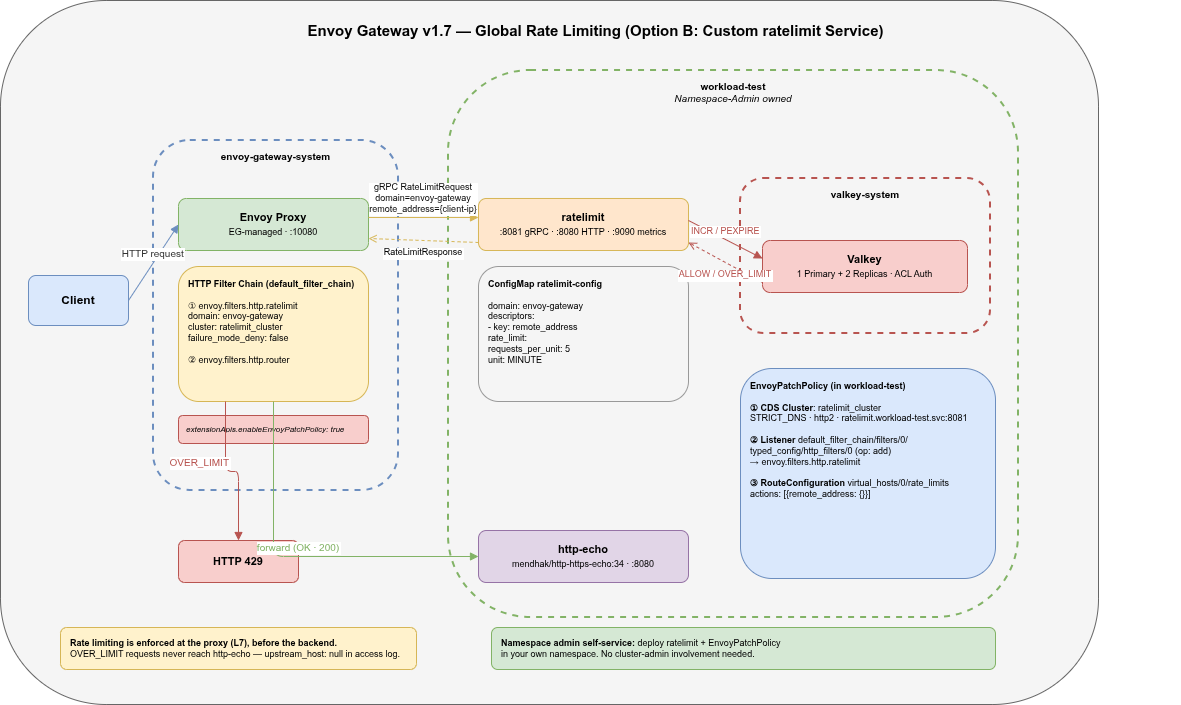
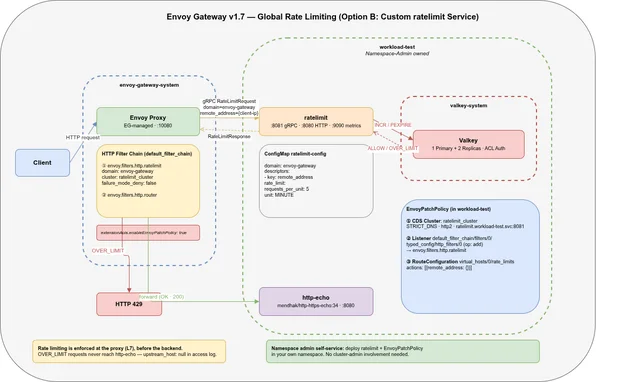
The full stack:
- Envoy Proxy (EG-managed,
envoy-gateway-system) — receives all traffic, runs the HTTP filter chain - ratelimit (
workload-test) —envoyproxy/ratelimit:master, gRPC on:8081, metrics on:9090 - Valkey (
valkey-system) — 1 Primary + 2 Replicas, ACL auth, stores per-IP counters - http-echo (
workload-test) — upstream backend, never sees rate-limited requests
Rate limiting is enforced at the proxy, before the request reaches the backend. A 429 response has upstream_host: null in the Envoy access log — the backend is never contacted.
The Three Required xDS Patches🔗
EnvoyPatchPolicy is a Kubernetes-native way to inject raw xDS config into EG-managed Envoy proxies. For Option B, three patches are required:
Patch 1 — CDS Cluster🔗
Adds a new upstream cluster so Envoy can reach the ratelimit gRPC service:
- type: "type.googleapis.com/envoy.config.cluster.v3.Cluster"
  name: ratelimit_cluster
  operation:
    op: add
    path: ""
    value:
      name: ratelimit_cluster
      type: STRICT_DNS
      connect_timeout: "10s"
      http2_protocol_options: {}
      load_assignment:
        cluster_name: ratelimit_cluster
        endpoints:
          - lb_endpoints:
              - endpoint:
                  address:
                    socket_address:
                      address: ratelimit.workload-test.svc.cluster.local
                      port_value: 8081
http2_protocol_options: {} is required — the ratelimit gRPC API is HTTP/2 only.
Patch 2 — Listener HTTP Filter🔗
Inserts the ratelimit HTTP filter into the Envoy listener’s filter chain, before the router:
- type: "type.googleapis.com/envoy.config.listener.v3.Listener"
  name: "workload-test/eg/http"
  operation:
    op: add
    path: "/default_filter_chain/filters/0/typed_config/http_filters/0"
    value:
      name: envoy.filters.http.ratelimit
      typed_config:
        "@type": "type.googleapis.com/envoy.extensions.filters.http.ratelimit.v3.RateLimit"
        domain: envoy-gateway
        failure_mode_deny: false
        timeout: "0.25s"
        rate_limit_service:
          transport_api_version: V3
          grpc_service:
            envoy_grpc:
              cluster_name: ratelimit_cluster
failure_mode_deny: false means fail-open — if the ratelimit service is unreachable, requests pass through. Set to true for strict enforcement.
domain must match the domain: field in the ratelimit ConfigMap.
What domain is — and what it isn’t: domain is not an HTTP hostname or DNS name. It is a plain string that the ratelimit service uses as a key namespace prefix in Redis/Valkey. Every counter the service stores is keyed as {domain}_{descriptor_key}_{value} — for example workload-test_client_ip_1.2.3.4. It serves two purposes: it selects which block of descriptors in the config file applies to this request (a single ratelimit service can serve multiple domains from one config), and it isolates counters between deployments that share the same Redis instance. Two namespaces that each set a unique domain value (e.g. workload-test and workload-prod) will never share a counter even on the same Valkey.
Patch 3 — RouteConfiguration rate_limits🔗
Without this patch, Envoy sends requests to the ratelimit service with no descriptors — it has no idea what to ask about. This patch tells Envoy which descriptor to generate per request.
Behind a reverse proxy or load balancer the real client IP arrives in X-Forwarded-For (de-facto standard) or Forwarded (RFC 7239). Using request_headers picks up these headers instead of the TCP source address, which would just be the proxy IP.
Two rules cover both headers. Each rule uses skip_if_absent: true so the rule is silently dropped if the header is absent rather than blocking the request:
- type: "type.googleapis.com/envoy.config.route.v3.RouteConfiguration"
  name: "workload-test/eg/http"
  operation:
    op: add
    path: "/virtual_hosts/0/rate_limits"
    value:
      # Rule 1: rate-limit by X-Forwarded-For (de-facto standard)
      - actions:
          - request_headers:
              header_name: x-forwarded-for
              descriptor_key: client_ip
              skip_if_absent: true
      # Rule 2: rate-limit by Forwarded (RFC 7239)
      - actions:
          - request_headers:
              header_name: forwarded
              descriptor_key: client_ip
              skip_if_absent: true
Both rules write to the same descriptor key client_ip. The ratelimit service matches it:
domain: workload-test
descriptors:
  - key: client_ip
    rate_limit:
      requests_per_unit: 100
unit: MINUTENote: if a request carries both headers, it matches both rules and is counted twice per request. In practice, a well-configured upstream proxy sets exactly one of them. If you need strict single-count behaviour, pick one header and remove the other rule.
For environments where neither header is set (direct access, no proxy), add a third fallback rule using remote_address:
      # Rule 3: fallback to TCP source IP when no proxy headers are present
      - actions:
          - remote_address: {}
Unlike request_headers, the remote_address action has no descriptor_key parameter — it always generates a descriptor with the fixed key remote_address. The ratelimit config must therefore list both keys:
descriptors:
  - key: client_ip      # matches rules 1 and 2 (header-based)
    rate_limit:
      requests_per_unit: 100
      unit: MINUTE
  - key: remote_address # matches rule 3 (direct access fallback)
    rate_limit:
      requests_per_unit: 100
      unit: MINUTE
If remote_address is omitted from the config, rule 3 fires but matches nothing — direct-access requests are not rate-limited.
EG v1.7 Breaking Changes🔗
1. EnvoyPatchPolicy must be explicitly enabled🔗
EG v1.7 ships with EnvoyPatchPolicy disabled by default. Without this flag, the policy stays in ACCEPTED: False with reason Disabled:
# values.yaml (Helm) or envoy-gateway-config ConfigMap
config:
  envoyGateway:
    extensionApis:
      enableEnvoyPatchPolicy: true
Or patch the running ConfigMap directly:
kubectl patch configmap envoy-gateway-config \
  -n envoy-gateway-system --type=merge \
  -p '{"data":{"envoy-gateway.yaml":"...\nextensionApis:\n  enableEnvoyPatchPolicy: true\n"}}'
kubectl rollout restart deployment/envoy-gateway -n envoy-gateway-system
2. Listener structure: default_filter_chain🔗
The Listener xDS resource uses default_filter_chain as the main filter chain. Patching the wrong path silently creates a broken entry (missing @type) and the policy ends up PROGRAMMED: False with an unmarshal error. The correct path is:
/default_filter_chain/filters/0/typed_config/http_filters/0ratelimit Container: Distroless Image🔗
envoyproxy/ratelimit:master uses a distroless base image — no shell, no package manager. The OCI manifest has no ENTRYPOINT or CMD, so the deployment must specify it explicitly:
containers:
  - name: ratelimit
    image: envoyproxy/ratelimit:master
    command: ["/bin/ratelimit"]
Without command, the pod crashes immediately with no command specified.
The same distroless constraint means no kubectl exec debugging — use port-forward to reach the debug endpoint:
kubectl port-forward -n workload-test deploy/ratelimit 6070:6070
# check loaded config
curl http://localhost:6070/rlconfig
# envoy-gateway.client_ip: unit=MINUTE requests_per_unit=5
ConfigMap Volume: subPath Fix🔗
Mounting the ratelimit ConfigMap without subPath causes a duplicate domain panic at startup. The goruntime library follows Kubernetes’ ..data symlink and loads config.yaml twice:
# broken — goruntime sees config.yaml twice via ..data symlink
volumeMounts:
  - name: config
    mountPath: /srv/runtime_data/current/config

# fixed — single file, no symlink traversal
volumeMounts:
  - name: config
    mountPath: /srv/runtime_data/current/config/config.yaml
    subPath: config.yaml
    readOnly: true
Namespace Admin Self-Service🔗
The entire Option B setup lives in the workload namespace. A namespace admin (who has no cluster-admin access) can deploy rate limiting independently:
workload-test/
├── Deployment/ratelimit            # the ratelimit service
├── Service/ratelimit               # :8081 gRPC, :8080 HTTP, :9090 metrics
├── ConfigMap/ratelimit-config      # domain + descriptors (what to limit)
├── Secret/ratelimit-redis          # Valkey credentials
├── EnvoyPatchPolicy/ratelimit-patch # wires EG to this ratelimit instance
├── Gateway/eg                      # Gateway API entry point
├── HTTPRoute/http-echo             # route to backend
└── Deployment/http-echo            # the actual workload
The cluster admin provides:
- The Envoy Gateway installation (with
enableEnvoyPatchPolicy: true) - A shared Valkey cluster in
valkey-system
Everything else is namespace-scoped and namespace-admin-controlled.
Deployment🔗
The full setup — Kustomize base, overlays for AKS, GKE, OpenShift, and local k3s, Helm chart with platform-specific values files, Terraform + Ansible for the test cluster, and the Valkey + Envoy Gateway install scripts — is available at envoy-gateway-ratelimit.
The Kustomize overlays handle platform differences (topology spread constraints on AKS/GKE, OpenShift SCC constraints, namespace-scoped secrets) while sharing a common base. The Helm chart exposes the same knobs via values.yaml for teams that prefer Helm.
Kustomize (local k3s overlay)🔗
# 1. Create the secret with Valkey credentials
kubectl create secret generic ratelimit-redis \
  -n workload-test \
  --from-literal=REDIS_URL=valkey.valkey-system.svc.cluster.local:6379 \
  --from-literal=REDIS_AUTH=<password>

# 2. Deploy ratelimit into workload-test
kustomize build deploy/kustomize/overlays/local | kubectl apply -f -

# 3. Deploy the test workload (http-echo, Gateway, HTTPRoute, EnvoyPatchPolicy)
VALKEY_PASSWORD=<password> ./setup/test-workload/install.sh
The overlays/local kustomization sets namespace: workload-test and removes the ServiceMonitor (no prometheus-operator on k3s) and placeholder Secret.
Helm🔗
helm install ratelimit deploy/helm/ratelimit \
  -f deploy/helm/ratelimit/values-aks.yaml \
  --set redis.secretName=ratelimit-redis \
  -n workload-test --create-namespace
Platform-specific values files are provided for AKS, GKE, and OpenShift.
Test🔗
After deployment, verify the ratelimit service loaded its config:
kubectl port-forward -n workload-test deploy/ratelimit 6070:6070
curl -s http://localhost:6070/rlconfig
# envoy-gateway.client_ip: unit=MINUTE requests_per_unit=5
Check the EnvoyPatchPolicy was accepted and programmed:
kubectl get envoypatchpolicy -n workload-test
# NAME              ACCEPTED   PROGRAMMED   AGE
# ratelimit-patch   True       True         2m
Fire 8 requests against the gateway (limit is 5/min per source IP):
GATEWAY_IP=$(kubectl get svc -n envoy-gateway-system \
  -l 'gateway.envoyproxy.io/owning-gateway-namespace=workload-test' \
  -o jsonpath='{.items[0].status.loadBalancer.ingress[0].ip}')

for i in $(seq 1 8); do
  echo -n "req $i: "
  curl -so /dev/null -w '%{http_code}' "http://${GATEWAY_IP}/"
  echo
done
Expected output:
req 1: 200
req 2: 200
req 3: 200
req 4: 200
req 5: 200
req 6: 429
req 7: 429
req 8: 429
The Envoy access log confirms rate limiting happens before the upstream:
{
  "response_code": 429,
  "response_code_details": "request_rate_limited",
  "response_flags": "RL",
  "upstream_host": null
}
What About TCPRoute and TLSRoute?🔗
The HTTP filter chain approach only works for HTTPRoute (and GRPCRoute, which shares the HCM). For TCPRoute and TLSRoute, there is no HTTP filter layer — Envoy operates at L4. The envoy.filters.network.ratelimit (L4) filter exists but only supports remote_address and destination_port descriptors. SNI-based rate limiting on TLSRoute is not possible without TLS termination, since the payload is encrypted and SNI is only visible in the ClientHello.
What About Istio?🔗
If your cluster runs Istio instead of Envoy Gateway, the same envoyproxy/ratelimit service and the same Redis/Valkey backend work — the concepts are identical because Istio also uses Envoy as its data plane. The difference is only in how you wire the integration: instead of EnvoyPatchPolicy, Istio uses EnvoyFilter to inject the ratelimit HTTP filter and the CDS cluster into the sidecar or gateway proxy.
The ratelimit config (domain, descriptors) and the descriptor generation logic (header-based or remote_address) stay exactly the same. A ratelimit service deployed for an EG setup can be reused in an Istio setup without any changes to the service itself — only the wiring resource changes.
Istio’s own documentation covers the EnvoyFilter-based approach: Istio — Rate Limiting. The main gotcha when coming from EG: Istio’s EnvoyFilter targets individual workloads or gateways via workloadSelector, and the filter insertion path in the xDS structure differs from EG’s default_filter_chain layout.
Repository🔗
The full Kustomize base + overlays (AKS, GKE, OpenShift, local), Helm chart, Terraform/Ansible cluster setup, and test workload scripts are in envoy-gateway-ratelimit.