Istio AuthorizationPolicy & HTTP/2 Coalescing
Isolating an admin surface behind its own hostname and an IP-restricted Istio AuthorizationPolicy sounds like a Tuesday-afternoon change: add a second HTTPRoute, add a DENY policy with an allowlist, done. Two non-obvious Envoy behaviors turned it into a two-day debugging exercise instead — one in how AuthorizationPolicy resolves “the client’s IP,” and one in how browsers reuse HTTP/2 connections across hostnames that share a certificate. Neither is specific to Keycloak or to this particular setup; both apply to any Istio or Envoy Gateway API ingress sitting behind a cloud load balancer with a shared wildcard certificate.
This post walks through both bugs, how they were root-caused, and the fix for each — so the next person hitting either symptom can skip straight to the cause.
Setup🔗
The scenario: a public hostname (auth.example.com) serves an application’s normal authentication endpoints, and a second hostname (auth-admin.example.com) is meant to serve the same backend’s administrative surface, reachable only from a small IP allowlist. Both hostnames share one wildcard TLS certificate on the same Istio Gateway. The cluster sits behind a cloud load balancer that speaks the PROXY protocol, so Envoy can recover the real client IP instead of just seeing the load balancer’s own TCP connection.
An AuthorizationPolicy with action: DENY and a negated IP match handles the allowlisting:
apiVersion: security.istio.io/v1
kind: AuthorizationPolicy
metadata:
  name: admin-restrict
spec:
  selector:
    matchLabels:
      gateway.networking.k8s.io/gateway-name: ingress-gateway
  action: DENY
  rules:
    - to:
        - operation:
            hosts: ["auth-admin.example.com"]
      from:
        - source:
            notIpBlocks:
              - "203.0.113.7/32"
DENY with negation, rather than an ALLOW policy, is deliberate: as soon as any ALLOW policy matches a workload selector, Istio flips that entire workload to default-deny for everything else — every other host on the same gateway would need its own explicit ALLOW rule too. A DENY policy with a negated match only affects the hosts it names.
Deployed as written above, this policy returned 403 for the allowlisted IP itself.
AuthorizationPolicy: direct_remote_ip vs. remote_ip🔗
The first instinct when a 403 shows up for an IP that should be allowed is to check the CIDR: typo, wrong /32 vs. /24, IPv4 vs. IPv6. None of that was wrong here. The next instinct was that notIpBlocks might not be the right field — Istio’s AuthorizationPolicy API exposes three IP-matching options that look interchangeable: source.ip, ipBlocks/notIpBlocks, and remoteIpBlocks/notRemoteIpBlocks. Switching from notIpBlocks to source.ip with a notValues condition changed nothing — still 403 for the allowlisted IP.
That symptom — identical behavior across two supposedly different fields — is the tell that both resolve to the same underlying value. Confirming it required looking past the Istio CRD to what Envoy actually compiles the policy into, via a live config dump:
kubectl exec <istio-ingress-pod> -n <ns> -- \
  pilot-agent request GET config_dump?resource=dynamic_listeners
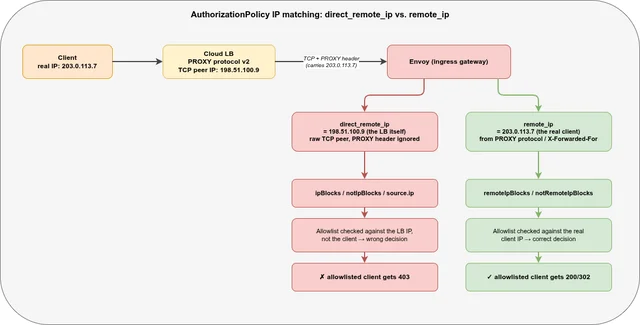
The compiled RBAC filter showed direct_remote_ip for the CIDR match — not remote_ip. Cross-checking against the Istio API proto source confirms it explicitly: source.ip, ipBlocks, and notIpBlocks all compile to Envoy’s direct_remote_ip, described in Envoy’s own docs as the address of the immediate TCP connection peer. Sitting behind a load balancer, that peer is the load balancer itself, not the browser that originated the request — the real client IP only reaches Envoy inside the PROXY protocol header (or an X-Forwarded-For entry), and only the remoteIpBlocks/notRemoteIpBlocks fields read that value (Envoy’s remote_ip).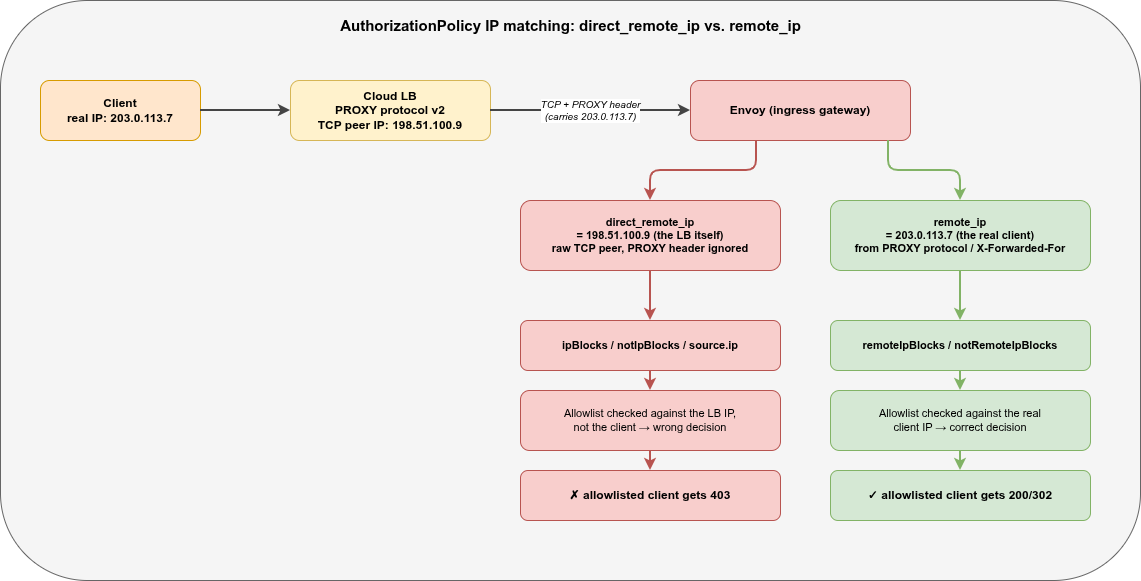
The fix is a one-field swap:
      from:
        - source:
            notRemoteIpBlocks:
              - "203.0.113.7/32"
Verifying this live — before templating the fix — was done with kubectl patch directly against the running policy: swap the field, confirm the allowlisted IP stops getting 403; then patch the CIDR list to a different, non-matching IP as a negative-control test and confirm 403 returns for the real client. Both checks passed before the change was committed to the source template.
Takeaway: source.ip, ipBlocks, and notIpBlocks in an Istio AuthorizationPolicy never see past the immediate TCP peer. Behind any proxy, load balancer, or PROXY-protocol listener, the only fields that read the actual client IP are remoteIpBlocks/notRemoteIpBlocks. When the two appear to produce identical results, that’s a sign they’re reading the same underlying field, not that the policy is correct.
HTTP/2 connection coalescing across per-hostname listeners🔗
With the IP-matching fixed, the allowlisted IP stopped getting 403 — but the admin interface still failed to load in the browser, with a timeout on a background check the application ran against its own login-status endpoint. curl against the exact same URL, from the same IP, reliably returned 200.
The Envoy access log for the failing request had two fields worth comparing:
authority: auth.example.com
requested_server_name: auth-admin.example.com
response_code_details: route_not_found
The request was addressed to auth.example.com, but its TLS SNI (requested_server_name) was auth-admin.example.com — a different hostname than the one actually being requested. The browser had opened its connection for auth-admin.example.com, then reused that same open HTTP/2 connection to request a resource on auth.example.com instead of opening a new one.
That behavior is spelled out in RFC 7540 §9.1.1: an HTTP/2 client is permitted to reuse an existing connection for a different origin whenever a certificate valid for both origins is available on that connection. A single wildcard certificate covering every hostname on the gateway makes that condition true for all of them — coalescing isn’t a bug in the browser, it’s specified behavior, and a curl invocation never triggers it because curl opens one connection per invocation and doesn’t opportunistically reuse it across hostnames.
The Gateway in this setup had one Envoy listener per hostname — each with its own SNI-keyed filter chain and its own, independent route table. A request that arrives over a connection opened for a different hostname’s filter chain finds no route for its actual target host in that filter chain’s table, producing exactly the route_not_found seen in the log.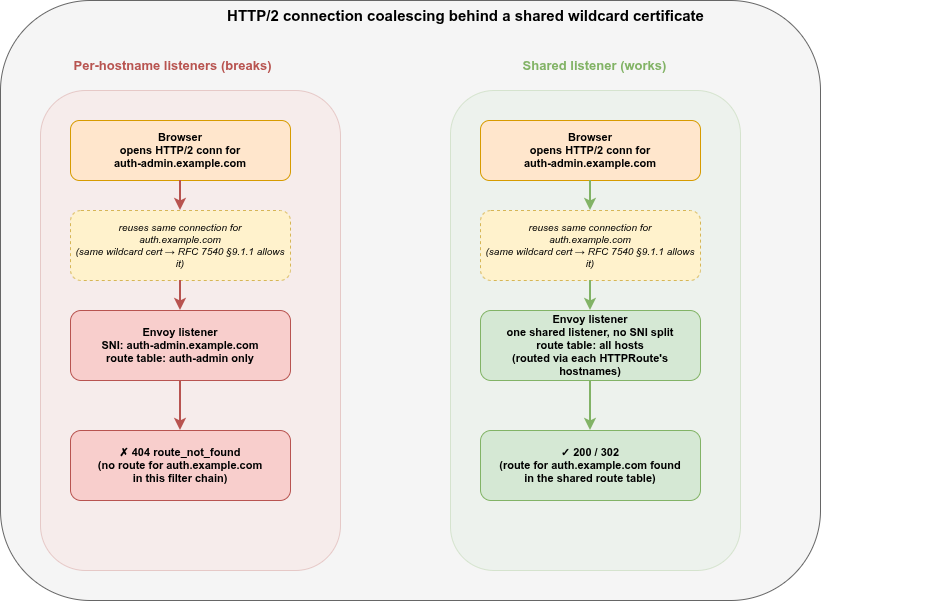
The fix collapses the per-hostname listeners into a single shared listener on port 443, with no hostname field restricting it to one SNI value:
listeners:
  - name: https
    port: 443
    protocol: HTTPS
    tls:
      mode: Terminate
      certificateRefs:
        - name: wildcard-tls
    allowedRoutes:
      namespaces:
        from: All
Host-based routing keeps working exactly as before, because it was never actually tied to the listener count — each HTTPRoute’s own hostnames field is what Envoy uses to route a request to the right backend, regardless of which listener or SNI value the connection came in on. One shared listener means one shared route table, so a coalesced request finds the right route no matter which hostname’s connection carried it in.
Takeaway: any Gateway API setup with more than one hostname behind a single certificate — a wildcard cert is the common case — should route those hostnames through one shared listener, not one listener per hostname. Per-hostname listeners work fine until a client coalesces two of them onto the same connection, at which point routing breaks for exactly the requests that happen to travel over a reused connection — intermittent-looking, browser-dependent, and invisible to curl.
Takeaways for your own Istio ingress🔗
- If an
AuthorizationPolicyIP allowlist denies the IP it’s supposed to allow, check which field is doing the matching before checking the CIDR.remoteIpBlocks/notRemoteIpBlocksare the only fields that see past a load balancer or reverse proxy to the real client IP. - When in doubt about what an
AuthorizationPolicyactually compiles to, read Envoy’s ownconfig_dumprather than inferring behavior from the CRD field names alone —ipBlocksandremoteIpBlockssound like they should differ only in strictness, not in which network hop they inspect. - Multiple hostnames sharing one certificate on the same Gateway are candidates for HTTP/2 connection coalescing. A per-hostname Envoy listener setup will misroute exactly those coalesced requests — test with a real browser, not only
curl, before ruling this out. - A
DENYpolicy with a negated match, rather than anALLOWpolicy, avoids collaterally flipping every other host on the same Gateway to default-deny.
Summary🔗
Two Istio/Envoy behaviors that look correct in the YAML and still produce the wrong result in practice: AuthorizationPolicy IP fields that silently match the wrong network hop, and HTTP/2 clients that silently reuse connections across hostnames sharing a certificate. Both were only visible by comparing Envoy’s actual compiled configuration and access logs against what the higher-level API implied — the RBAC decision and the routing decision each happen one layer below where the policy is written.