ingress-nginx Hard Cases: Auth, Rate Limits, gRPC, Snippets
Every earlier part of this series was research: read the source, read the docs, verify a claim against a repo. This one is different. A real OVH Managed Kubernetes Service (MKS) cluster, a real domain, one deliberately nasty sample application, and the exact same 10-request test script run against ingress-nginx, then Envoy Gateway, then HAProxy Unified Gateway. Every result below is a real HTTP response or a real line read out of a running pod, not a docs claim.
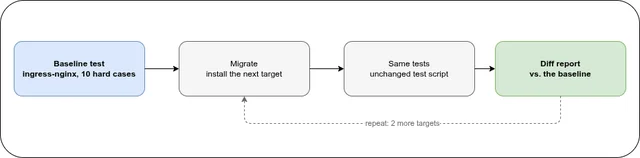
A single-node OVH MKS cluster ran all three targets, one at a time, against the same 10 hard cases: TLS, regex rewrite, canary, external auth, rate limit, WebSocket, gRPC, a large body, a tight timeout, and one snippet. Six cases behaved identically everywhere. Four did not: rate limiting diverges three different ways across the three targets (ingress-nginx’s own 5x burst multiplier and 503s, Envoy Gateway’s stricter token bucket and 429s, HAProxy Unified Gateway’s complete lack of enforcement); external auth shows the same no-enforcement gap on HAProxy Unified Gateway; gRPC has no equivalent there at all (no GRPCRoute kind exists in that controller); and ingress-nginx’s default Strict-Transport-Security header silently disappears on both Gateway API targets unless you re-add it (a trivial fix, but easy to forget), something none of the 10 hard cases were even designed to ask about. The single most structurally interesting finding: HAProxy Unified Gateway needs one HTTPRoute per host, not one per hard case — a real, load-bearing constraint found by reading a generated HAProxy config file inside a running pod, not guessed at. Every version pinned below is exactly what was actually installed on 2026-07-17/18 — expect specific bugs and gaps mentioned here to move as each project ships new releases.
The lab🔗
The cluster is a real, single-node OVH MKS instance (Kubernetes v1.35.2, 4 vCPU / 16GiB), started from a clean slate — no Gateway API CRDs, no IngressClass, nothing but the default kube-system workloads. TLS uses real Let’s Encrypt staging certificates via cert-manager’s DNS-01 challenge against a real domain, issued through this blog’s own cert-manager-webhook-libdns. The real lab domain has been replaced by the placeholder hard-case.example (RFC 2606’s reserved documentation TLD) everywhere in this article and in the companion repo — the two hostnames that matter are lab.hard-case.example for every HTTP/HTTPS case and grpc.lab.hard-case.example for gRPC, which needs its own host since gRPC method paths are fixed by the .proto file and can’t be usefully prefix-matched the way plain HTTP paths can.
The sample app is mccutchen/go-httpbin (an actively maintained, official multi-arch image — no fork, no custom build) plus moul/grpcbin for the gRPC case, run as two versions (go-httpbin-v1/-v2) so the canary case has something real to split traffic between. All ten hard cases and their exact manifests live in the companion repo, ingress-nginx-migration-lab, on Codeberg — every command, every YAML file, every raw result below is reproducible from that repo directly, not reconstructed from notes.
Each target ran the identical test script (tests/run-tests.sh) against whatever was live at the time, with results committed as timestamped Markdown files under tests/results/. Three phases:
- Baseline — ingress-nginx, Helm chart v4.15.1, the current stable release before this lab makes any changes at all.
- Envoy Gateway v1.8.2 — installed via its own
gateway-helmchart, which bundles both the upstream Gateway API CRDs and Envoy Gateway’s own CRDs in one install. - HAProxy Unified Gateway (“HUG”) v1.0.5 — installed from plain manifests (no Helm chart in this project’s public repo), the latest stable tag.
HAProxy Unified Gateway is a materially younger project than Envoy Gateway, confirmed by reading its actual source rather than assuming from its README: at v1.0.5 it implements only HTTPRoute from the Gateway API — no GRPCRoute kind exists in the controller at all — and it has no dedicated rate-limit or external-auth policy CRD (only low-level, raw-HAProxy-config primitives like stick-table ACLs and an auth_realm field for HTTP Basic/Digest auth, not a portable Gateway API policy attachment). Two decisions were made up front, before any live test, to keep the comparison honest rather than force a result: rate limit and external auth are documented as unsupported with no live attempt, and gRPC is documented as a flat capability gap with no live attempt, since there’s no GRPCRoute kind to even try. That leaves 6 of 10 hard cases actually tested against HUG: TLS, canary, WebSocket, regex rewrite, large body, and tight timeout.
Results at a glance🔗
| Hard case | ingress-nginx | Envoy Gateway v1.8.2 | HAProxy Unified Gateway v1.0.5 | Verdict |
|---|---|---|---|---|
| TLS | 200 | 200 | 200 | Equivalent |
| Regex rewrite | rewritten path served | rewritten path served | rewritten path served | Equivalent |
| Canary (20 req.) | 11/9 split | 10/10 split | 9/11 split | Equivalent |
| WebSocket echo | round-trip OK | round-trip OK | round-trip OK | Equivalent |
| Large body (5MB) | 200 | 200 | 200 | Equivalent (no size cap anywhere) |
| Tight timeout | 504 | 504 | 504 | Equivalent — but see findings below |
| External auth | 401/200 (enforced) | 401/200 (enforced) | 404 (not enforced) | Real gap (HUG) |
| Rate limit (20 req.) | 11/9 200/503 | 2/18 200/429 | 404 ×20 (not enforced) | Real divergence (all three differ) |
| gRPC | 5 services listed | 5 services listed | not attempted — no GRPCRoute kind | Capability gap (HUG) |
| Snippet | 200 + custom header | 404 — no route | 404 — no route | Expected gap (by design, both targets) |
Last verified: 2026-07-17/18 — Kubernetes v1.35.2, ingress-nginx Helm chart v4.15.1, Envoy Gateway v1.8.2, HAProxy Unified Gateway v1.0.5.
Walking through the hard cases🔗
TLS🔗
All three targets terminate TLS with the same cert-manager-issued Secret and serve 200 on GET /get. ingress-nginx’s Ingress just lists the host and secretName:
spec:
  tls:
    - hosts:
        - lab.hard-case.example
      secretName: hard-case-lab-tls
Both Gateway API targets reuse the exact same Secret through a listener’s tls.certificateRefs — no new certificate issuance needed for either migration:
listeners:
  - name: https
    port: 443    # 31443 on HAProxy Unified Gateway — see the fixed-port finding below
    protocol: HTTPS
    tls:
      mode: Terminate
      certificateRefs:
        - name: hard-case-lab-tls
No RCA needed — clean equivalence on all three.
Regex rewrite🔗
ingress-nginx’s use-regex + a capture-group rewrite-target sends /rewrite/foo to /anything/foo:
annotations:
  nginx.ingress.kubernetes.io/use-regex: "true"
  nginx.ingress.kubernetes.io/rewrite-target: /anything/$1
spec:
  rules:
    - http:
        paths:
          - path: /rewrite/(.*)
            pathType: ImplementationSpecific
Core Gateway API’s URLRewrite filter only supports prefix replacement, not arbitrary regex capture groups — narrower in general (Part 3 already flagged capture-group rewrites as a red case for core Gateway API), but sufficient for this specific hard case since the captured suffix carries through unchanged either way:
rules:
  - matches:
      - path: { type: PathPrefix, value: /rewrite }
    filters:
      - type: URLRewrite
        urlRewrite:
          path: { type: ReplacePrefixMatch, replacePrefixMatch: /anything }
Identical on both Envoy Gateway and HUG. No RCA needed — this specific case’s shape happens to sit entirely inside what ReplacePrefixMatch can do.
Canary🔗
ingress-nginx’s canary model needs a second Ingress object sharing the same host and path, marked canary: "true" — the weight isn’t a field on the primary object at all:
annotations:
  nginx.ingress.kubernetes.io/canary: "true"
  nginx.ingress.kubernetes.io/canary-weight: "50"
Gateway API doesn’t need the second-object split — weighted backendRefs on one HTTPRoute cover both the primary and canary backend directly, a genuine portability win over ingress-nginx’s own mechanism:
backendRefs:
  - name: go-httpbin
    port: 80
    weight: 50
  - name: go-httpbin-canary
    port: 80
    weight: 50
Identical on HUG too (it has its own dedicated blue-green example proving the same mechanism). Split ratios across a 20-request sample (11/9, 10/10, 9/11) are all within normal sampling noise of a 50/50 weight — no RCA needed.
WebSocket🔗
No annotation on ingress-nginx at all — it proxies Upgrade/Connection headers by default. No special configuration on either Gateway API target either; both proxy the upgrade the same way. Echo round-trip (hard-case-ws-probe sent and received back intact) confirmed on all three. Worth naming as an operational aside rather than a controller finding: the test tooling itself needed three attempts before finding a WebSocket client image that worked correctly against TLS (see “Test methodology” below) — the controllers were never the problem here. What finally worked was docker.io/mtilson/websocat, a community fork built specifically to fix this exact TLS crash in the original vi0oss/websocat image.
Large body (5MB POST)🔗
No explicit size cap found on any of the three targets during this test — ingress-nginx’s proxy-body-size: 25m annotation is set generously above the 5MB test payload rather than removed entirely (a limit was configured, just not tight enough to trigger), and neither Envoy Gateway’s ClientTrafficPolicy nor HUG’s Backend/Defaults CRDs were configured with any equivalent cap for this lab. 200 on all three. Not a finding about equivalence — an open question this specific lab run didn’t push hard enough to answer, carried over unchanged from Part 4’s own note on the same gap.
Tight timeout🔗
Symptom: all three targets return 504 for a request whose backend (/delay/5) deliberately runs longer than the configured proxy timeout (3s) — on the surface, a clean pass everywhere.
Evidence: ingress-nginx’s proxy-read-timeout: "3" is a plain annotation. Both Gateway API targets use the identical core field, rules[].timeouts.backendRequest: 3s:
rules:
  - matches:
      - path: { type: PathPrefix, value: /slow }
    filters:
      - type: URLRewrite
        urlRewrite: { path: { type: ReplacePrefixMatch, replacePrefixMatch: /delay/5 } }
    timeouts:
      backendRequest: 3s
Root cause of why this is a real finding, not a boring pass: Part 4’s own empirical testing of Envoy Gateway found an overwrite bug on this exact field — BackendRequest unconditionally overwriting Request without a Retry block, producing wrong effective timeouts. Separately, this lab’s own Phase C planning stage predicted, from a source grep that found no “BackendRequest” string in HUG’s route-translation code, that the field probably wasn’t handled by HUG at all.
Fix or accepted limitation: neither pessimistic prediction held up live. Envoy Gateway v1.8.2 returns a clean 504 with no sign of the Part 4 overwrite bug — it appears fixed since that testing. HUG’s case needed direct evidence, not a repeat grep: reading the actual generated /usr/local/hug/haproxy.cfg inside the running pod showed timeout server 3000 on the timeout route’s backend, exactly matching the configured 3s — the field is correctly translated, the earlier grep had simply missed the actual code path.
Migration lesson: a grep for a field’s Go identifier finding nothing is weaker evidence than reading the live, generated configuration — prefer the latter whenever the two disagree, and don’t present a grep-based absence as confirmed non-support without a live check to back it up.
External auth🔗
Symptom: ingress-nginx and Envoy Gateway both enforce correctly — 401 without a bearer token, 200 with one. HAProxy Unified Gateway returns 404 in both cases.
Evidence: ingress-nginx’s auth-url points at go-httpbin’s own /bearer endpoint as the subrequest target:
annotations:
  nginx.ingress.kubernetes.io/auth-url: "http://go-httpbin.hard-case-lab.svc.cluster.local/bearer"
Envoy Gateway’s SecurityPolicy does the same thing through extAuth.http, with one real correction needed during setup: the plain path field prepends to the original request path (producing /auth/protected, not what’s wanted), so pathOverride — which replaces the path outright — is required instead, confirmed from the field’s own doc comment before it was ever tested live:
extAuth:
  http:
    backendRefs:
      - name: go-httpbin
        port: 80
    pathOverride: /bearer
HUG has no such CRD at all — its only auth-adjacent primitive is auth_realm on the Backend/ Defaults CRDs, which implements HTTP Basic/Digest auth, not delegation to an external service.
Root cause: the 404 is coincidental, not a stricter or looser enforcement decision. The request reaches go-httpbin directly through HUG’s catch-all route, unauthenticated — go-httpbin itself simply has no /protected route of its own, so its own router returns Go’s stdlib default “404 page not found” text. There is no enforcement happening at all.
Fix or accepted limitation: documented capability gap, confirmed via source before the live test (no external-auth CRD exists in the controller), and confirmed live (the exact 404 text proves the request wasn’t intercepted by any policy layer at all).
Migration lesson: “the response code looks like a failure” and “the request was rejected by a security policy” are two different claims — always check why a response looks the way it does before treating a status code as proof of enforcement, especially when a capability is already known to be absent going in.
Rate limit🔗
Symptom: three different behaviors across three targets, none of them the same.
Evidence: 20 concurrent requests against each target, tallied by status code:
- ingress-nginx (
limit-rps: "2"): 11×200, 9×503. - Envoy Gateway (
BackendTrafficPolicy,rateLimit.local.rules[].limit: {requests: 2, unit: Second}): 2×200, 18×429. - HAProxy Unified Gateway: 20×
404— the same no-enforcement passthrough as the external-auth case above, not a rate-limit decision at all.
# Envoy Gateway's BackendTrafficPolicy — same nominal limit as ingress-nginx's limit-rps: "2"
rateLimit:
  type: Local
  local:
    rules:
      - limit:
          requests: 2
          unit: Second
Root cause: ingress-nginx applies its own default 5x burst multiplier on top of the configured rate — a burst of 10 against 20 concurrent requests lets roughly half through. Envoy Gateway’s local rate limit is a plain token bucket with no documented implicit burst at all — a much stricter enforcement of the same nominal “2 req/s” number. HUG has no rate-limit policy CRD, so the 404 is the identical catch-all-passthrough finding as external auth, not a third distinct enforcement style.
Fix or accepted limitation: none needed for ingress-nginx or Envoy Gateway — both enforce something, just at different strictness and with different HTTP semantics (503 reads as a generic server-side failure; 429 explicitly signals “you were rate-limited, retry”). HUG’s gap is the same accepted, documented capability limitation as external auth.
Migration lesson: “same nominal rate-limit number” does not mean “same client-visible behavior.” A client that treats 503 and 429 differently (different retry logic, different alerting) will behave differently after this specific migration even though the configured number didn’t change — this is exactly the kind of silent behavioral drift Part 3’s annotation matrix exists to warn about, now confirmed live instead of just predicted.
gRPC🔗
Symptom: ingress-nginx and Envoy Gateway both correctly proxy gRPC reflection, listing the same 5 services. HAProxy Unified Gateway was never actually tested — and one line in this lab’s raw Phase C result file looks like a HUG result but isn’t.
Evidence: ingress-nginx uses backend-protocol: GRPC on its own host (gRPC method paths are fixed by the .proto, so they can’t be prefix-matched the way HTTP paths can); Envoy Gateway uses the distinct GRPCRoute kind on its own listener. Both list:
addsvc.Add
grpc.gateway.examples.examplepb.ABitOfEverythingService
grpc.reflection.v1alpha.ServerReflection
grpcbin.GRPCBin
hello.HelloService
Root cause of the stray result line: grpc.lab.hard-case.example still resolved, via real DNS untouched since the baseline phase, to ingress-nginx’s own LoadBalancer IP when the HUG test run happened — because gRPC correctly wasn’t attempted against HUG (per the scope decision above), the test script’s GRPC_HOST_IP override was correctly left unset, and grpcurl silently fell through to real DNS and tested the still-live baseline instead of HUG.
Fix or accepted limitation: documented capability gap — no GRPCRoute kind exists anywhere in HUG’s controller code, confirmed from source before any test was attempted. The stray result line is struck from this lab’s findings, not counted as evidence either way.
Migration lesson: when a target is deliberately excluded from one test in a shared test harness, double-check that the harness itself doesn’t quietly fall back to a still-live peer target’s endpoint through DNS or default routing — an intentional gap and an accidental one can produce output that looks identical unless the underlying network path is checked, not just the response body.
Snippet🔗
ingress-nginx’s configuration-snippet injects an arbitrary raw NGINX directive — real custom proxy code, not configuration, requiring allow-snippet-annotations to even be enabled (a real security trade-off this lab makes deliberately, on a controller that ships this gate off by default):
annotations:
  nginx.ingress.kubernetes.io/configuration-snippet: |
    add_header X-Lab-Snippet "nginx-only-no-portable-equivalent" always;
200 plus the custom header on ingress-nginx; 404 — no route exists at all — on both Envoy Gateway and HUG, since neither has anything resembling a snippet mechanism and no route was ever created to intentionally exercise the gap. This is the same “no portable equivalent by design” finding Part 3 already named for every migration target evaluated in this series, now surfaced more starkly than a matrix cell can: the whole path is unreachable, not just one custom header missing.
Gotchas that aren’t about any one hard case🔗
Five real findings surfaced during setup and during header-level diffing, not during any single hard-case test — each still gets the same RCA treatment, because each one would bite a real migration exactly the same way.
The default HSTS header disappears on both Gateway API targets🔗
Symptom: none of the 10 hard cases asked about response headers beyond the one custom header in the snippet case — but diffing the full response headers across all three targets, not just status codes, surfaced a security-relevant difference nothing was testing for.
Evidence: ingress-nginx’s TLS response carries strict-transport-security: max-age=31536000; includeSubDomains on every HTTPS response. Neither Envoy Gateway nor HAProxy Unified Gateway sends any Strict-Transport-Security header at all — the same GET /get over HTTPS comes back without it on both.
Root cause: ingress-nginx enables HSTS by default in its own global configuration; the two Gateway API targets make no such default policy decision. This is a difference in default posture, not a capability gap — both targets implement the core Gateway API ResponseHeaderModifier filter (confirmed from source at the installed versions: Envoy Gateway v1.8.2 ships a dedicated response-header task, and HAProxy Unified Gateway v1.0.5 handles HTTPRouteFilterResponseHeaderModifier in k8s/gate/haproxy/filters/http_filters.go, with its own integration test for it). Adding HSTS back is a two-line filter on the same HTTPRoute, on either target:
filters:
  - type: ResponseHeaderModifier
    responseHeaderModifier:
      add:
        - name: Strict-Transport-Security
          value: "max-age=31536000; includeSubDomains"
Fix or accepted limitation: not a bug, and not hard to fix — but easy to forget. The header is opt-in on both Gateway API targets and opt-out (on by default) on ingress-nginx, so a migration that doesn’t explicitly re-add it silently drops a header real browsers act on, with no error, no failed test, and nothing in a status-code-only comparison to catch it.
Migration lesson: diff full response headers before and after a migration, not just status codes and bodies. The most consequential difference in this entire lab was a header that no hard case was designed to test, and the fix is trivial once you know to look — it only showed up because the comparison looked at everything the response carried, not just whether the request succeeded.
OVH’s PROXY-protocol annotation doesn’t reach Envoy Gateway’s Service🔗
Symptom: Envoy Gateway’s auto-created LoadBalancer Service was missing the OVH MKS PROXY-protocol annotation (loadbalancer.openstack.org/proxy-protocol: "v2") that preserves the real client IP at the load balancer.
Evidence: kubectl get svc ... -o jsonpath='{.metadata.annotations}' showed no such annotation after the first apply, even though Gateway API’s own Gateway.spec.infrastructure.annotations field had been set with exactly that intent.
Root cause: spec.infrastructure.annotations is documented but is not propagated to the auto-created Service by Envoy Gateway — a real portability gap, not a misconfiguration.
Fix: Envoy Gateway’s own EnvoyProxy CRD, referenced from the Gateway via spec.infrastructure.parametersRef:
apiVersion: gateway.envoyproxy.io/v1alpha1
kind: EnvoyProxy
metadata:
  name: eg-proxy-config
  namespace: hard-case-lab   # must match the Gateway's own namespace — parametersRef is
                              # local-only, confirmed from gateway-api's own type definitions
spec:
  provider:
    type: Kubernetes
    kubernetes:
      envoyService:
        annotations:
          loadbalancer.openstack.org/proxy-protocol: "v2"
That annotation only makes the load balancer send a PROXY protocol preamble — Envoy’s own listener doesn’t parse it unless separately told to via a ClientTrafficPolicy, whose own doc comment states plainly that “Proxy Protocol must be present when this field is set, else the connection is closed.” The two sides of this contract were wired up together, before any test traffic was sent, not discovered as an outage afterward. The specific field name shifted between versions too: this repo’s current main branch has a structured proxyProtocol.version field, but the actual installed v1.8.2 release only has the older enableProxyProtocol boolean — confirmed by checking the source out at the exact installed tag (git show v1.8.2:api/v1alpha1/clienttrafficpolicy_types.go) after a live “unknown field” rejection, not by trusting the local clone’s default branch.
Migration lesson: PROXY-protocol propagation is always a two-sided contract — the load balancer must send it and the proxy must be told to expect it — and when checking a project’s source for a specific field name or struct, check it out at the exact tag actually installed, not whatever the local clone’s working tree happens to be on.
HAProxy Unified Gateway’s own CRDs aren’t in the standard install🔗
Symptom: the first kubectl apply -k against HUG’s manifests created everything except its Global and HugConf custom resources, failing with “no matches for kind … ensure CRDs are installed first.”
Root cause: HUG’s own CRDs (Global, HugConf, Defaults, Backend, HugGate, under gate.v3.haproxy.org) are separate from the standard Gateway API CRDs and aren’t installed by any manifest in the project’s own example/deploy/hug/ — they need a one-shot Job (hug --job-check-crd) with its own, more privileged ServiceAccount, deliberately kept separate from the running controller’s own more limited RBAC.
Fix: run that Job once, before applying anything else. HUG’s install docs also offer a companion job (--job-gwapi=1.5.0) that installs the standard Gateway API CRDs — deliberately not run in this lab, since Envoy Gateway’s own gateway-helm chart had already installed a newer set and HUG only needs HTTPRoute, already present; running a second, possibly different-versioned Gateway API CRD install risked disturbing what the still-live Envoy Gateway phase depended on, for no benefit.
Migration lesson: “installed the Gateway API CRDs” and “installed this controller’s own custom resources” are two separate steps for at least one real project in this space — check for a controller-specific CRD-install mechanism explicitly, rather than assuming one Helm/manifest install covers everything a quickstart doc implies.
HAProxy Unified Gateway needs one HTTPRoute per host, not per hard case🔗
Symptom: after fixing the CRD-ordering issue above, every path except one returned a plain 404 — including paths that should have matched a route that was demonstrably applied and Accepted.
Evidence: kubectl exec into the running controller pod and reading its generated HAProxy config directly (not inferring from the symptom) showed the actual problem: /usr/local/hug/maps/hug_https_31443/listener_route_exact_match.map had the identical key (hard-case-lab/hug_https/lab.hard-case.example) repeated four times, once per HTTPRoute object, each with a different value.
Root cause: HUG selects which HTTPRoute serves a request via a HAProxy map() lookup keyed by (listener, host) — not (listener, host, path). With four separate HTTPRoute objects all on the same host, the generated map has four entries under one identical key, and HAProxy’s map() converter on a duplicate key returns only the first-declared value. Every path belonging to any of the other three routes 404s from backend_not_found, regardless of what path was actually requested. (This symptom briefly raised the question of whether ingress-nginx and Envoy Gateway, still running on separate LoadBalancer IPs alongside HUG, might be colliding somehow — ruled out immediately: each Gateway API controller filters strictly by its own controllerName, and all three targets have entirely separate LoadBalancer IPs. The cause was entirely internal to HUG’s own per-host route-selection map.)
Fix: consolidate every attempted hard case into one HTTPRoute per host, with multiple rules[] inside it, instead of one HTTPRoute object per hard case — the pattern that worked without issue on both ingress-nginx (separate Ingress objects, a different mechanism entirely) and Envoy Gateway (which has no problem with multiple HTTPRoute objects on one host).
Migration lesson: “one Gateway API resource per hard case” is a style choice that happened to work on two of the three targets in this lab — not a Gateway API guarantee. At least one real implementation imposes a structural one-route-per-host constraint underneath a spec that otherwise allows either shape.
HAProxy Unified Gateway’s Service reconciles back to its own fixed ports🔗
Symptom: the controller’s Service, explicitly configured to map external ports 80/443 to the container’s 31080/31443, silently reverted to serving on 31080/31443 directly.
Evidence: the Service’s own last-applied-configuration annotation still showed the intended 80→31080/443→31443 mapping, but the live spec had been renamed (http-31080/https-31443) and re-pointed to ports 31080/31443 literally — confirmed by watching the two diverge after the controller’s own reconciliation loop ran, then confirmed live: port 443 on this load balancer times out entirely, 31443 serves traffic.
Root cause: HUG’s controller actively reconciles its managed Service back to its own fixed container ports — there is no per-Gateway auto-provisioned LoadBalancer the way Envoy Gateway has; one shared data-plane process serves every Gateway object on those same two fixed ports.
Fix or accepted limitation: accepted as a real architectural difference, not something to fight — the test script gained a HOST_PORT override (default 443, set to 31443 for this phase) rather than trying to force the Service onto standard ports.
Migration lesson: confirm which port a target’s load balancer actually serves traffic on before trusting a manifest’s stated intent — for at least one real implementation, the controller’s own reconciliation loop overrides the manifest silently, with no error or event surfaced anywhere.
Test methodology, not controller bugs🔗
Four bugs surfaced in the test script itself during the very first baseline run against ingress-nginx — worth naming so none of them get misattributed to a controller, but kept brief since none are migration findings: the canary tally was meaningless until go-httpbin’s USE_REAL_HOSTNAME env var was set (otherwise every pod reports an identical dummy hostname); the rate-limit test needed 20 concurrent requests, not sequential ones, to ever trigger a limit at all; the large-body test’s first 400 was curl’s own default Content-Type for --data-binary tripping go-httpbin’s form-decoding, fixed with an explicit Content-Type: application/octet-stream header; and the WebSocket test needed a third container image (docker.io/mtilson/websocat) before finding one that didn’t either not exist or crash on TLS. All four were fixed once, in the shared test script, before any comparison run — every phase after the baseline reused the corrected logic unchanged.
What this lab does and doesn’t prove🔗
This is one real migration, not a statistically representative one. A single-node cluster, Let’s Encrypt staging certificates that were never promoted to production, and no real production load or concurrency behind any of these results — the rate-limit and canary numbers above are real observed counts, not numbers from a load-testing tool built for statistical confidence. Only 2 of the 8 candidates from Part 4’s matrix got a live migration here, chosen for the sharpest contrast between two Gateway API implementations at different maturity levels, not because the other 6 wouldn’t be worth testing too. And go-httpbin itself never got a security review as a production application — it’s a well-known, purpose-built test target, not a stand-in for a real backend.
Sources🔗
ingress-nginx-migration-lab— the companion repo: every manifest, every command, every raw result file this article is drawn from- envoyproxy/gateway — source, tag
v1.8.2 - haproxytech/haproxy-unified-gateway — source, tag
v1.0.5 - kubernetes-sigs/gateway-api — core API types referenced throughout (
HTTPRoute,GRPCRoute,Timeouts,URLRewrite) - mccutchen/go-httpbin — the sample application
- moul/grpcbin — the gRPC test backend
- Part 3 — The Matrix — the per-annotation findings this lab’s results are checked against
- Part 4 — Replacement Candidates — source of the Envoy Gateway timeout-overwrite bug this lab confirms fixed at v1.8.2
What’s next🔗
This closes the empirical arc of this series — every part in the original plan is now published. The series hub still tracks publication status, but per its own stated intent, that doesn’t mean the series is finished: Part 3’s living annotation matrix, and any future target or annotation worth adding to it, can still grow independently of this lab’s own scope. If you’re migrating your own cluster off ingress-nginx, the companion repo is built to be re-run against your own targets, not just read.
Series
ingress-nginx MigrationA practical field guide to migrating off the retired ingress-nginx controller: inventory, annotation compatibility, migration mechanics, and a companion lab.
ingress-nginx is retired, not retiring — the GitHub repo was archived in March 2026. What changed, the CVEs disclosed since, and four honest ways forward.
Before comparing replacement controllers, find out what your ingress-nginx clusters actually depend on: annotations, the global ConfigMap, and controller flags.
Why classifying ingress-nginx annotations by name is dangerous: what migrates cleanly to Gateway API or another Ingress controller, and what silently breaks.
A source-verified look at Envoy Gateway, two HAProxy controllers, F5's NGINX controller, and NGINX Gateway Fabric, scored against the Part 3 matrix.
How Cilium, Traefik, and Kong score against the Part 3 matrix, plus a survey of AKS, GKE, STACKIT, and OVH ingress and Gateway API paths on managed Kubernetes.
An ingress2gateway walkthrough, coexistence patterns, DNS cutover, cert-manager, external-dns, and a rollback plan for a flag-day-free ingress-nginx migration.
A real OVH MKS lab migrates one nasty sample app from ingress-nginx to Envoy Gateway and HAProxy Unified Gateway: ten hard cases, real bugs, real gaps.