ingress-nginx Migration Mechanics: ingress2gateway and Cutover
Parts 3 through 5 answered what migrates cleanly and to which target. This part answers the question every migration guide owes its reader eventually: how do you actually move traffic without a flag day? A converter tool, a coexistence window, a staged cutover, and — the section every migration plan needs but few write down — an actual rollback plan.
ingress2gateway v1.0.0 (released 2026-03-21) recognizes 47 distinct nginx.ingress.kubernetes.io/* annotations in its ingress-nginx provider — more than the “30+” figure sometimes quoted, confirmed by reading the source directly. It converts most of Part 3’s “clean” annotations syntactically without issue, but flatly skips almost every hard case this series has covered: no rate limiting, no auth-url/auth-signin, no snippets, no tcp-services/ udp-services. Even where it does convert cleanly — the Timeouts field is the sharpest example — a successful conversion is not proof of equivalent behavior; Part 4 already found three different failure modes hiding behind that one field, per target. The rest of this part is the mechanics around the tool: coexistence, DNS-staged cutover, cert-manager and external-dns on Gateway API, monitoring, smoke tests, and a rollback plan as its own section, not an afterthought.
It is done when traffic, logs, redirects, headers, TLS, auth, timeouts, canaries, and rollback have all been verified — not when kubectl apply exits zero. Every section below assumes that bar.
ingress2gateway: what it actually converts🔗
ingress2gateway v1.0.0 shipped 2026-03-21 (confirmed via the tag’s own commit date — “reportedly 2026-03-20” was one day off). Its ingress-nginx provider recognizes 47 distinct nginx.ingress.kubernetes.io/* annotation strings, confirmed by reading the provider’s source directly rather than trusting a release-notes figure — one dedicated Go file per feature (canary.go, rewrite.go, session_affinity.go, backend_protocol.go, timeouts.go, cors.go, ssl_passthrough.go, bodysize.go, iprange.go, redirect.go, approot.go, backend_tls.go, headers.go).
What converts cleanly, syntactically: weight- and header/cookie-based canary, simple prefix/full-path rewrites, custom headers, CORS, body size, backend-protocol, session affinity (the core SessionPersistence field), the three timeout annotations (into core Timeouts), SSL passthrough, allow/deny source ranges, redirects, and app-root. Each has real test coverage in the tool’s own repo, not just a mapping table.
Where it gives up entirely: none of Part 3’s hardest cases appear anywhere in that annotation list — no rate-limit family, no auth-url/auth-signin, no modsecurity-snippet or any other snippet annotation, no tcp-services/udp-services. If your own Ingress objects depend on any of these, ingress2gateway has nothing to convert; the manual work Part 3’s per-annotation findings already describe is the actual plan for those rows, not a tool run.
What output still needs review: the tool has a real notification mechanism, not silent best-effort guessing — notifications.WarningNotification and notifications.ErrorNotification fire per-annotation for exactly the cases that need a human look (an unsupported value, a malformed canary-weight, a canary-weight exceeding canary-weight-total). Read the tool’s own output, not just the generated YAML.
The Timeouts field is the sharpest example of why a clean conversion still needs verification. ingress2gateway parses proxy-connect-timeout/proxy-read-timeout/proxy-send-timeout (unitless seconds, confirmed from timeouts.go) straight into Gateway API’s core Timeouts field without complaint. But Part 4 already found three different failure modes hiding behind that exact field, per target: Cilium collapses both sub-fields via min(), Envoy Gateway’s BackendRequest unconditionally overwrites Request without a Retry block, and NGINX Gateway Fabric rejects the field outright. A successful ingress2gateway run proves the annotation was recognized — it proves nothing about what your specific target actually does with it. Re-check the relevant part’s per-target findings after every conversion, not just after picking a target.
Coexistence patterns🔗
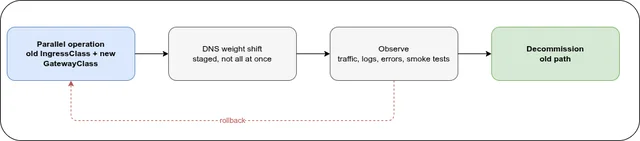
Running the old and new controller side by side is the standard way to avoid a flag day: a separate IngressClass for the retiring controller and a separate GatewayClass for the new one, both pointed at different subsets of traffic (by hostname, by namespace, or by an explicit migration label) while the cutover is staged. This is general Kubernetes practice, not something this blog’s own infrastructure has done for an ingress-nginx migration specifically — none of this blog’s own production clusters ever ran ingress-nginx (confirmed in the previous part’s research), so this section is deliberately generic guidance, not a retold migration story.
DNS-staged cutover and the LoadBalancer swap🔗
A staged cutover shifts traffic gradually rather than repointing DNS all at once: weighted DNS records (where the provider supports it) or a temporary dual-listener setup that accepts traffic on both the old and new LoadBalancer Service during the observation window. Only after the new path has carried real production traffic without incident does the old LoadBalancer get decommissioned — not before, and not automatically on a timer.
cert-manager with Gateway API🔗
cert-manager’s Gateway API support is a real, separate controller — the gateway-shim, gated behind the --enable-gateway-api flag — confirmed from source (internal/controller/feature/features.go, cmd/controller/app/options/options.go). It watches Gateway resources for cert-manager.io/* annotations the exact same way the core controller watches Ingress — the annotation-driven certificate-request model carries over, only the watched resource type changes.
One layer below that — the actual DNS-01 challenge against a specific DNS provider — is a separate concern cert-manager delegates to a webhook solver, regardless of whether the certificate request came from an Ingress or a Gateway. This blog’s own cert-manager-webhook-libdns is one such webhook — its provider registry is now generated from the project’s own compatibility-report data rather than a small hand-picked list, and compiles in 72 libdns provider implementations from one codebase, confirmed by running --list-providers against the current build. Worth knowing about specifically because it’s agnostic to this migration: the same webhook keeps working unchanged whether the ClusterIssuer it serves is triggered from Ingress or Gateway resources.
Last verified 2026-07-17 against git001/cert-manager-webhook-libdns main @ 06e90ea, via its own --list-providers output.
external-dns with Gateway API sources🔗
external-dns fully supports Gateway API as a DNS source, via five dedicated source flags: --source=gateway-httproute, -grpcroute, -tlsroute, -tcproute, and -udproute. Version requirements differ by route kind — HTTPRoute and Gateway need Gateway API v1.0.0+ (the v1 API), GRPCRoute needs v1.1.0+, while TCPRoute/UDPRoute remain on the experimental v1alpha2 API with no standard-channel release date yet. One concrete limitation worth planning around: TCPRoute/UDPRoute specs can’t carry hostnames at all, so external-dns falls back to the external-dns.alpha.kubernetes.io/hostname annotation for those — HTTPRoute and TLSRoute should specify every intended hostname in the route spec itself instead, since the annotation fallback isn’t reliably recognized by the actual Gateway serving the traffic.
Last verified 2026-07-17 against kubernetes-sigs/external-dns’s own Gateway API source docs.
Monitoring and access-log comparison before and after🔗
Compare the same signals across both paths during the coexistence window, not just after cutover: request rate, error rate, and latency percentiles per route, plus a direct access-log diff for the specific hard-case annotations Part 3 flagged as risky for your own cluster. If your monitoring stack already ingests access logs into a queryable store, reuse it here rather than building a one-off comparison — this blog’s own SigNoz on OVH MKS: Access Log Reports with Vector and ClickHouse post covers one concrete way to build exactly that kind of before/after reporting.
Smoke tests🔗
Before shifting any real traffic weight, run the same request set — normal paths, the specific hard-case annotations your own inventory (Part 2) flagged, and at least one deliberately malformed request — against the new path directly, bypassing DNS. A smoke-test failure caught here is far easier to act on than the same failure discovered after a weight shift has already moved real traffic.
Rollback plan🔗
This gets its own section deliberately, not a bullet inside the cutover section — a plan that only exists as “shift the DNS weight back” is not a rollback plan, since state that changed underneath the new path (a rotated certificate, a re-provisioned LoadBalancer IP, an external-dns record update) doesn’t necessarily revert just because traffic does. Before cutover starts, confirm: the old IngressClass’s LoadBalancer and DNS records still exist and are reachable, the old certificate hasn’t been allowed to expire during the coexistence window, and the actual rollback step (a DNS weight change, a Service selector flip, or both) has been tested at least once in a non-production environment. A rollback plan that has never been executed is a hypothesis, not a plan.
Security review after snippet removal🔗
Part 3 named ingress-nginx’s snippet annotations as this migration’s clearest “no” — arbitrary NGINX configuration injected through an annotation is real custom proxy code, not configuration, and every target this series evaluated either has no equivalent at all or gates the same capability behind a structured, narrower mechanism. Removing snippet annotations during a migration is a genuine security improvement, but only if it’s actually verified rather than assumed: audit what each removed snippet was doing (the required per-annotation line from Part 3 — “no portable equivalent by design” — should have been landing in this exact review already), and confirm the replacement mechanism (a policy CRD, a vendor extension, or a deliberate “not supported, redesign needed”) actually covers the same behavior before treating the snippet as safely gone.
What this doesn’t answer yet🔗
None of the mechanics above are specific to any one target from Parts 4 or 5 — the same coexistence/cutover/rollback shape applies whether the destination is Envoy Gateway, HAProxy Unified Gateway, or a managed-cloud Gateway API path. What differs by target is entirely covered in those earlier parts: which annotations survive, and which mechanism replaces the ones that don’t. Part 7 puts all of this into one deliberately nasty sample application and migrates it for real.
Sources🔗
- kubernetes-sigs/ingress2gateway — source, main branch (v1.0.0 tag confirmed 2026-03-21)
- cert-manager/cert-manager — source, confirms the
gateway-shim/--enable-gateway-apimechanism - kubernetes-sigs/external-dns — Gateway API source documentation
- libdns/libdns — the provider interface cert-manager-webhook-libdns implements against
- git001/cert-manager-webhook-libdns — source, main branch @
06e90ea - Part 3 — Annotation Compatibility Matrix — the per-annotation findings this part’s conversion coverage is checked against
- Part 4 — Replacement Candidates — source of the
Timeoutsfield’s three per-target failure modes cited above
What’s next🔗
Part 7 covers the hard cases: one deliberately nasty sample application — TLS, regex rewrite, canary, external auth, rate limit, WebSocket, gRPC, a large body, a tight timeout, and one snippet — migrated live, with every failure documented, not smoothed over. The series hub tracks what’s published; Part 5 covers the context-level candidates and managed-cloud survey.
Series
ingress-nginx MigrationA practical field guide to migrating off the retired ingress-nginx controller: inventory, annotation compatibility, migration mechanics, and a companion lab.
ingress-nginx is retired, not retiring — the GitHub repo was archived in March 2026. What changed, the CVEs disclosed since, and four honest ways forward.
Before comparing replacement controllers, find out what your ingress-nginx clusters actually depend on: annotations, the global ConfigMap, and controller flags.
Why classifying ingress-nginx annotations by name is dangerous: what migrates cleanly to Gateway API or another Ingress controller, and what silently breaks.
A source-verified look at Envoy Gateway, two HAProxy controllers, F5's NGINX controller, and NGINX Gateway Fabric, scored against the Part 3 matrix.
How Cilium, Traefik, and Kong score against the Part 3 matrix, plus a survey of AKS, GKE, STACKIT, and OVH ingress and Gateway API paths on managed Kubernetes.
An ingress2gateway walkthrough, coexistence patterns, DNS cutover, cert-manager, external-dns, and a rollback plan for a flag-day-free ingress-nginx migration.
A real OVH MKS lab migrates one nasty sample app from ingress-nginx to Envoy Gateway and HAProxy Unified Gateway: ten hard cases, real bugs, real gaps.