ingress-nginx Alternatives: Cilium, Traefik, Kong, AKS, GKE
Part 4 covered the five candidates source-verified with the same depth as the Part 3 matrix. This part covers the rest of what this series set out to compare: three candidates this series tests but doesn’t deep-dive — Cilium, Traefik, Kong — and a survey of what migrating off ingress-nginx looks like on four managed Kubernetes platforms that were never part of the empirical lab at all.
Cilium (6 green / 4 yellow / 7 red), Traefik (7/8/2), and Kong (2/10/5) score against the same 17-row matrix as Part 4’s candidates, at context level rather than deep-empirical. Cilium’s reds cluster around features that simply don’t exist on its Ingress/Gateway path (no rate limiting, no WAF, no session affinity); Kong’s yellows cluster around its own generic plugin bridge standing in for almost everything; Traefik’s actual strength is a dedicated ingress-nginx-compatibility provider most of the other candidates in this series don’t have at all. On managed clouds: AKS and GKE both ship a Gateway API path built specifically as an ingress-nginx successor; STACKIT has no managed Gateway API offering at all, only a managed Ingress-API alternative; OVH is represented here by this blog’s own self-managed Gateway API setup behind a plain LoadBalancer service; no vendor-managed ingress or Gateway API path was found in the docs reviewed for this series.
Context-level candidates: tested, not deep-dived🔗
“Context-level” is this series’ own term for a specific claim: these three candidates get scored against the same matrix as Part 4’s five, but the architecture facts behind each score come from a single source-verification pass, not the same depth as Part 4 (or the 8-agent audit Part 3 got). The distinction matters because “tested with this series’ full rigor” and “worth naming” are different claims — see the series hub for how the prompt driving this series scopes the two tiers.
| Candidate | Green | Yellow | Red | Config layer | Proxy engine |
|---|---|---|---|---|---|
| Traefik | 7 | 8 | 2 | Ingress/CRDs and HTTPRoute, separate provider packages bridged by ExtensionRef→Middleware | Traefik’s own native Go proxy |
| Cilium | 6 | 4 | 7 | Ingress or HTTPRoute, converging into one shared translation model | Embedded per-node Envoy (DaemonSet) — except TCPRoute/UDPRoute, which bypass it via eBPF |
| Kong | 2 | 10 | 5 | Ingress or HTTPRoute, one codebase for both (confirmed: both networking.k8s.io and HTTPRoute handlers present in source) | NGINX/OpenResty + Lua (Kong Gateway) |
Cilium🔗
Cilium’s ingestion code genuinely treats Ingress and HTTPRoute as separate paths, but both converge into one shared model.Model before either reaches Envoy — the same embedded, per-node Envoy instance the eBPF dataplane already runs, confirmed from source (operator/pkg/model/ingestion/{ingress,gateway}.go). The one exception is the newest addition: TCPRoute/UDPRoute reconciliation landed around June 2026 and deliberately bypasses that Envoy entirely, routing weighted traffic through Cilium’s own eBPF Maglev load-balancer instead (l4HasWeights, operator/pkg/model/translation/gateway-api/translator.go) — the one row in this whole matrix where a single candidate’s proxy-engine answer forks by route kind.
The seven reds are concentrated, not scattered: no rate-limiting code anywhere in the Ingress/ Gateway L7 path, no WAF or ModSecurity integration, and — despite Gateway API’s experimental SessionPersistence field existing in Cilium’s own vendored types — it is never actually read by the ingestion code, confirmed by a zero-hit grep. Where Cilium does implement a feature, though, it tends to be the standards-native answer: its ExternalAuth HTTPRoute filter support (auth-url/ auth-signin) is the most spec-faithful of any target in the whole series, reaching a real Envoy ext_authz filter through the actual core field rather than a vendor Policy CRD.
Last verified 2026-07-17 against cilium/cilium main @ eef7b9e (2026-07-14).
Traefik🔗
Traefik is this matrix’s one genuine outlier on the proxy-engine axis — its own native Go reverse proxy (&httputil.ReverseProxy{} from the stdlib, plus an experimental zero-allocation engine), not a wrapper around NGINX, HAProxy, or Envoy. Its Ingress/CRD path and its HTTPRoute path are separate provider packages, bridged only by a generic ExtensionRef→kind: Middleware registry.
What actually lifts Traefik’s score above Cilium’s and Kong’s is a mechanism no other candidate in this series has at all: a dedicated ingress-nginx-annotation-compatibility provider (pkg/provider/kubernetes/ingress-nginx/) that parses existing nginx.ingress.kubernetes.io/* annotations directly, including a bounded snippet interpreter for the auth path. Several of the matrix’s yellow verdicts for Traefik exist specifically because this compat provider’s own translated type is narrower than the generic Middleware CRD equivalent it resembles — the same “real path is narrower than the generic one” pattern Part 3 and Part 4 both ran into repeatedly. Its two reds are structural, not maturity gaps: no SessionPersistence support at all (not even attempted, per Traefik’s own checked-in conformance report), and UDPRoute confirmed unimplemented on the Gateway API path — no udproute.go file exists in the provider package.
Last verified 2026-07-17 against traefik/traefik main branch.
Kong🔗
Kong Kubernetes Ingress Controller is architecturally distinct from every other candidate in this series: one codebase answers both the classic Ingress API and HTTPRoute (confirmed — both a generated networking.k8s.io controller and a dedicated httproute_controller.go exist in the same source tree), and it’s an officially supported provider in kubernetes-sigs/ingress2gateway — the first time this series named “is this an ingress2gateway provider” as an explicit reason to include a candidate at all, rather than a fairness argument.
Kong’s ten yellows almost all funnel through the same generic bridge: a KongPlugin attached via either the konghq.com/plugins annotation (Ingress) or an ExtensionRef filter (HTTPRoute), confirmed from source (generateExtensionRefKongPlugin, internal/dataplane/translator/subtranslator/httproute.go). Rate limiting, external auth, and session affinity (via Kong’s own KongUpstreamPolicy CRD rather than core SessionPersistence) all reach Kong Gateway this same way — nearly every hard case in this matrix funnels through one generic mechanism rather than dedicated code, which is either a strength (one thing to learn) or a weakness (the actual logic runs in Kong Gateway, outside this controller’s own repository), depending on how much that indirection matters for your own operational model.
Last verified 2026-07-17 against kong/kubernetes-ingress-controller main @ e47c34066.
Managed cloud provider paths🔗
None of the four platforms below were part of this series’ empirical lab — what follows is a survey of what each one’s own documentation and, for OVH, this blog’s own production repos actually show, not a fourth round of source-verified testing. The headline finding: “managed Gateway API” and “managed ingress” do not imply one consistent runtime model across providers, even before either platform’s actual annotation compatibility enters the picture.
AKS and GKE🔗
Both platforms ship a Gateway API path specifically framed as an ingress-nginx successor — not to be confused with either platform’s separate cloud-native Gateway API product (Azure’s Application Gateway for Containers, GKE’s own multi-GatewayClass offering), which the existing Istio vs. Envoy Gateway comparison already covers in depth, including Cilium-CNI specifics and cross-cluster compatibility. The two paths are genuinely different products, not two names for the same thing.
AKS. The application-routing add-on’s Gateway API implementation (approuting-istio GatewayClass) deploys an in-cluster Istio control plane per cluster and is, as of AKS 1.36, the default ingress path on new AKS Automatic clusters. Microsoft’s own migration guidance is direct: managed-NGINX users on the application-routing add-on must migrate to this Gateway API implementation (or another supported one) by November 2026, when Azure support for the legacy NGINX-based add-on ends. Managed Gateway proxies get an autoscaling HorizontalPodAutoscaler and a PodDisruptionBudget per Gateway. Two concrete constraints worth knowing before adopting it: it cannot run alongside the separate Istio service-mesh add-on without first deleting that add-on’s CRDs and GatewayClass, and TLSRoute-based SNI passthrough isn’t supported until AKS adds Istio 1.30.
GKE. The GKE Gateway Controller is not hosted on the cluster’s control plane or in the user’s project at all — it runs externally and programs Google Cloud Load Balancer resources directly from HTTPRoute objects, an architecturally different model from AKS’s in-cluster-Istio approach. GKE’s own docs state every existing Ingress resource on GKE is directly convertible to Gateway/ HTTPRoute, and that the two can run simultaneously without conflict during a migration. GKE Ingress, the older controller, remains supported and was never ingress-nginx-based — it is unaffected by the retirement, same as AKS’s legacy NGINX add-on is a separate support question from the retirement itself.
Last verified 2026-07-17 against Microsoft Learn’s AKS application-routing Gateway API docs (ms.date: 2026-07-01) and Google Cloud’s GKE Gateway API concepts docs.
STACKIT🔗
STACKIT SKE’s Application Load Balancer (ALB) Ingress controller (stackit.cloud/alb-ingress, opt-in via extensions.applicationLoadBalancer.enabled: true) is built on the native Kubernetes Ingress API — as of this writing, STACKIT has no managed Gateway API offering at all, unlike AKS and GKE. Customers migrating off ingress-nginx on STACKIT get a vendor-managed Ingress-API alternative, not a vendor-managed Gateway API path; STACKIT’s own docs do include a “Moving from Ingress to Gateway API” section, signalling a transition is planned, not yet shipped as a managed product.
Two STACKIT-specific gotchas worth carrying over from this blog’s own AuthorizationPolicy/HTTP-2- coalescing research: the ALB selects TLS certificates purely by SNI, so — exactly the same shared-listener, shared-certificate failure mode covered in the AuthorizationPolicy and HTTP/2 connection coalescing post — a certificate from one Ingress can affect others sharing the same ALB. And three of the ALB’s own backend-TLS annotations still ship with a typo in STACKIT’s live docs, unchanged since first noted: alb.stackit.cloud/traget-pool-tls-enabled, -custom-ca, and -skip-certificate-validation (sic) — quoted here exactly as STACKIT’s own documentation states them; verify at deploy time whether the misspelling is docs-only or baked into the controller itself before writing a manifest around it.
STACKIT’s Kubernetes engine has its own broader constraints worth knowing before treating it as an ingress-only decision — see Who Builds the Platform? Ownership vs. Stack for SKE’s audit-logging gap and Gardener-based architecture.
Last verified 2026-07-17 against STACKIT’s own application-load-balancing docs (docs.stackit.cloud, page states last updated 2026-07-10).
OVH🔗
What’s actually confirmed, empirically, across two of this blog’s own production repositories — ovh-example-observability, and the LLM Inference on OVH series’ own gateway setup — is that every one of them self-manages Istio Ambient plus upstream kubernetes-sigs/gateway-api CRDs behind OVH’s plain LoadBalancer Service (OpenStack Octavia underneath), with zero ingress-nginx references and zero OVH-managed-ingress references anywhere in any of them. None of OVH’s own vendor documentation surfaced a managed ingress or Gateway API product in any of this series’ research either — worth stating as “not found in the repos this blog operates or in OVH’s own docs,” not as a vendor-wide claim that no such product exists anywhere, since a newer offering could exist that none of that research happened to touch. What the evidence does support is the real-world counter-example to AKS, GKE, and STACKIT’s managed paths in this survey: on OVH, “migrating off ingress-nginx” and “standing up your own Gateway API control plane” are, in practice, the same project, not two separate decisions. The flip side of that same absence is flexibility: without a vendor-managed ingress or Gateway API product to work around, OVH imposes no platform-level constraint on which Ingress controller or Gateway API implementation you run — any of the candidates covered across this series, or a mix, is equally viable, in a way none of AKS’s, GKE’s, or STACKIT’s own managed defaults are.
Last verified 2026-07-17 against this blog’s own ovh-example-observability and ovh-llm-inference repositories.
Four runtime models behind one label🔗
“Managed Gateway API” means something different on each of these four platforms, and the difference is architectural, not cosmetic: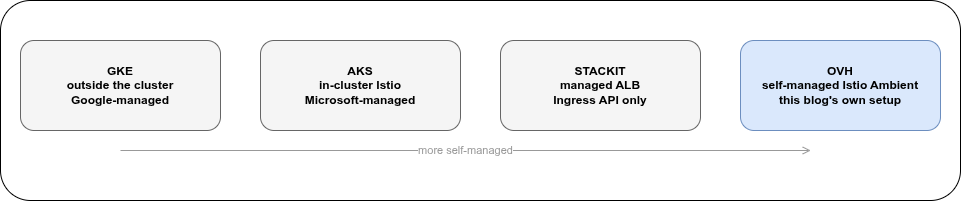
| Platform | Where the data plane runs | Who operates it |
|---|---|---|
| AKS (application-routing add-on) | In-cluster Istio proxies, per Gateway | Microsoft-managed lifecycle, customer-configured routes |
| GKE (Gateway Controller) | Outside the cluster entirely — Google Cloud Load Balancer | Fully Google-managed, no in-cluster proxy pod at all |
| STACKIT (ALB Ingress) | STACKIT-managed ALB, Ingress API only | STACKIT-managed, no Gateway API path yet |
| OVH (this blog’s own setup) | In-cluster Istio Ambient, self-deployed | Fully self-managed, upstream CRDs |
Treat “does provider X support Gateway API” as a question with at least two follow-ups before it’s useful for a migration decision: does the data plane run inside your cluster or outside it, and who is actually operating the lifecycle of whichever answer you get.
What this doesn’t answer yet🔗
Same caveat as Part 4: none of the above ranks these seven remaining candidates or four cloud paths against each other. Cilium’s standards-native auth filter, Traefik’s compat provider, and Kong’s one-codebase-both-APIs design each solve a different problem well; which one fits depends on constraints this survey can’t supply — which annotations your own Ingress objects depend on (Part 3), which of Part 4’s five deep candidates already covers your case, and which managed platform your workload already runs on. Migration Mechanics, covering ingress2gateway, coexistence patterns, and a staged cutover, is next.
Sources🔗
- cilium/cilium — Cilium (source, main branch @
eef7b9e, 2026-07-14) - traefik/traefik — Traefik (source, main branch)
- Kong/kubernetes-ingress-controller — Kong Kubernetes Ingress Controller (source, main branch @
e47c34066) - kubernetes-sigs/ingress2gateway — official provider list, including Kong’s own provider package
- AKS application routing with the Kubernetes Gateway API — learn.microsoft.com (
ms.date: 2026-07-01) - GKE Gateway API overview — cloud.google.com
- STACKIT Application Load Balancing — docs.stackit.cloud (last updated 2026-07-10)
- Part 3 — Annotation Compatibility Matrix — the 17-row matrix every score in this part is drawn from
- Part 4 — Replacement Candidates — the five deep-empirical candidates this part’s three context-level ones are compared against
What’s next🔗
Part 6 covers Migration Mechanics: an ingress2gateway walkthrough, coexistence patterns, DNS-staged cutover, and a rollback plan. The series hub tracks what’s published; Part 4 covers the five candidates tested with full empirical depth.
Series
ingress-nginx MigrationA practical field guide to migrating off the retired ingress-nginx controller: inventory, annotation compatibility, migration mechanics, and a companion lab.
ingress-nginx is retired, not retiring — the GitHub repo was archived in March 2026. What changed, the CVEs disclosed since, and four honest ways forward.
Before comparing replacement controllers, find out what your ingress-nginx clusters actually depend on: annotations, the global ConfigMap, and controller flags.
Why classifying ingress-nginx annotations by name is dangerous: what migrates cleanly to Gateway API or another Ingress controller, and what silently breaks.
A source-verified look at Envoy Gateway, two HAProxy controllers, F5's NGINX controller, and NGINX Gateway Fabric, scored against the Part 3 matrix.
How Cilium, Traefik, and Kong score against the Part 3 matrix, plus a survey of AKS, GKE, STACKIT, and OVH ingress and Gateway API paths on managed Kubernetes.
An ingress2gateway walkthrough, coexistence patterns, DNS cutover, cert-manager, external-dns, and a rollback plan for a flag-day-free ingress-nginx migration.
A real OVH MKS lab migrates one nasty sample app from ingress-nginx to Envoy Gateway and HAProxy Unified Gateway: ten hard cases, real bugs, real gaps.